Showing posts with label to. Show all posts

Thursday, November 20, 2014

Sine Wave To TTL Converter

Sine Wave To TTL Converter is a series that we can use to change the sine wave signal with a pulse shape with the same frequency with TTL logic level that we are ready to use in coding the data digitally . The series of Sine Wave To TTL Converter can be used to convert sine wave signal to form a TTL of frequency 100KHz to 80MHz at the level of 100mV - 2V. The series of Sine Wave To TTL Converter uses a 5VDC voltage source. The series of Sine Wave To TTL Converter was built from transistor T1 gets base bias from R3, R4 and R5. If the series Sine Wave Converter This TTL To get the input sine signal with a minimum level of 100mV, the circuit Sine Wave To TTL Converter This will generate an output signal with TTL level square wave.

The series of Sine Wave To TTL Converter has input + impedance - 50 Ohm which is set using the R6. To change the value of the input impedance converter circuit Sine Wave To this TTL can be set via the R6 with a maximum value of 300 ohms.
Read more

Friday, November 14, 2014

Digital to Analog Converter using Binary Weighted Resistors R 2R

The R-2R ladder DAC which is a binary-weighted DAC that uses a repeating cascaded structure of resistor values R and 2R. This improves the precision due to the relative ease of producing equal valued-matched resistors (or current sources). However, wide converters perform slowly due to increasingly large RC-constants for each added R-2R link. The D/A converter using binary-weighted resistors is shown in the figure below. In the circuit, the op-amp is connected in the inverting mode. The op-amp can also be connected in the non-inverting mode. The circuit diagram represents a 4-digit converter. Thus, the number of binary inputs is four.

Circuit Diagram


Fig. 1
We know that, a 4-bit converter will have 24 = 16 combinations of output. Thus, a corresponding 16 outputs of analog will also be present for the binary inputs.

Four switches from b0 to b3 are available to simulate the binary inputs: in practice, a 4-bit binary counter such as a 7493 can also be used.

Working

The circuit is basically working as a current to voltage converter.

1. b0 is closed
It will be connected directly  to the +5V.
Thus, voltage across R = 5V
Current through R = 5V/10kohm = 0.5mA
Current through feedback resistor, Rf = 0.5mA (Since, Input bias current, IB is negligible)
Thus, output voltage = -(1kohm)*(0.5mA) = -0.5V

2. b1 is closed, b0 is open
R/2 will be connected to the positive supply of the +5V.
Current through R will become twice the value of current (1mA) to flow through Rf.
Thus, output voltage also doubles.

3. b0 and b1 are closed
Current through Rf = 1.5mA
Output voltage = -(1kohm)*(1.5mA) = -1.5V

Thus, according to the position (ON/OFF) of the switches (bo-b3), the corresponding “binary-weighted” currents will be obtained in the input resistor. The current through Rf will be the sum of these currents. This overall current is then converted to its proportional output voltage. Naturally, the output will be maximum if the switches (b0-b3) are closed,

V0 = -Rf *([b0/R][b1/(R/2)][b2/(R/4)][b3/(R/8)]) 
Where each of the inputs b3, b2, b1, and b0 may either be HIGH (+5V) or LOW (0V).

The graph with the analog outputs versus possible combinations of inputs is shown below.

Fig. 2
The output is a negative going staircase waveform with 15 steps of -).5V each. In practice, due to the variations in the logic HIGH voltage levels, all the steps will not have the same size. The value of the feedback resistor Rf changes the size of the steps. Thus, a desired size for a step can be obtained by connecting the appropriate feedback resistor. The only condition to look out for is that the maximum output voltage should not exceed the saturation levels of the op-amp. Metal-film resistors are more preferred for obtaining accurate outputs.

Disadvantages

If the number of inputs (>4) or combinations (>16) is more, the binary-weighted resistors may not be readily available. This is why; R and 2R method is more preferred as it requires only two sets of precision resistance values.

Read more

Thursday, November 13, 2014

Transistor Schmitt Trigger Oscillator

The Schmitt Trigger oscillator below employs 3 transistors, 6 resistors and a capacitor to generate a square waveform. Pulse waveforms can be generated with an additional diode and resistor (R6). Q1 and Q2 are connected with a common emitter resistor (R1) so that the conduction of one transistor causes the other to turn off. Q3 is controlled by Q2 and provides the squarewave output from the collector.


In operation, the timing capacitor charges and discharges through the feedback resistor (Rf) toward the output voltage. When the capacitor voltage rises above the base voltage at Q2, Q1 begins to conduct, causing Q2 and Q3 to turn off, and the output voltage to fall to 0. This in turn produces a lower voltage at the base of Q2 and causes the capacitor to begin discharging toward 0. When the capacitor voltages falls below the base voltage at Q2, Q1 will turn off causing Q2 and Q3 to turn on and the output to rise to near the supply voltage and the capacitor to begin charging and repeating the cycle. The switching levels are established by R2,R4 and R5. When the output is high, the voltage at the base of Q2 is determined by R4 in parallel with R5 and the combination in series with R2. When the output is low, the base voltage is set by R4 in parallel with R2 and the combination in series with R5. This assumes R3 is a small value compared to R2. The switching levels will be about 1/3 and 2/3 of the supply voltage if the three resistors are equal (R2,R4,R5).

There are many different combinations of resistor values that can be used. R3 should low enough to pull the output signal down as far as needed when the circuit is connected to a load. So if the load draws 1mA and the low voltage needed is 0.5 volts, R3 would be 0.5/.001 = 500 ohms (510 standard). When the output is high, Q3 will supply current to the load and also current through R3. If 10 mA is needed for the load and the supply voltage is 12, the transistor current will be 24 mA for R3 plus 10 mA to the load = 34 mA total. Assuming a minimum transistor gain of 20, the collector current for Q2 and base current for Q3 will be 34/20 = 1.7 mA. If the switching levels are 1/3 and 2/3 of the supply (12 volts) then the high level emitter voltage for Q1 and Q2 will be about 7 volts, so the emitter resistor (R1) will be 7/0.0017 = 3.9K standard. A lower value (1 or 2K) would also work and provide a little more base drive to Q3 than needed. The remaining resistors R2, R4, R5 can be about 10 times the value of R1, or something around 39K.

The combination of the capacitor and the feedback resistor (Rf) determines the frequency. If the switching levels are 1/3 and 2/3 of the supply, the half cycle time interval will be about 0.693*Rf*C which is similar to the 555 timer formula. The unit I assembled uses a 56K and 0.1 uF cap for a positive time interval of about 3.5 mS. An additional 22K resistor and diode were used in parallel with the 56K to reduce the negative time interval to about 1 mS.

In the diagram, T1 represents the time at which the capacitor voltage has fallen to the lower trigger potential (4 volts at the base of Q2) and caused Q1 to switch off and Q2 and Q3 to switch on. T2 represents the next event when the capacitor voltage has risen to 8 volts causing Q2 an Q3 to turn off and Q1 to conduct. T3 represents the same condition as T1 where the cycle begins to repeat. Now, if you look close on a scope, you will notice the duty cycle is not exactly 50% This is due to the small base current of Q1 which is supplied by the capacitor. As the capacitor charges, the E/B of Q1 is reverse biased and the base does not draw any current from the capacitor so the charge time is slightly longer than the discharge. This problem can be compensated for with an additional diode and resistor as shown (R6) with the diode turned around the other way. 
Read more

Wednesday, October 29, 2014

6V to 12V Converter Circuit with BD679 BC547

This is a design circuit for converter circuit. This circuit is based on transistor as controller the circuit. There are two types of transistor that is BC547 and BD679. This circuit is a simple design of converter or inverter. This is the figure of the circuit.

This inverter circuit can to 800mA of 12V power supply with a 6V. For example could you 12V Car Accessories (UK turning into a 6V?) Car. The circuit is simple, more than 75% efficiency and very helpful. By changing a few components you, you also change for different voltages.

Electronic Part List

R1, R4 2 .2 K 1/4W Resistor

R2, R3 47K 1/4W Resistor

R5 1K 1/4W Resistor

R6 15K 1/4W Resistor

R7 33K 1/4W Resistor

R8 10K 1/4W Resistor

C1, C2 0.1uF Ceramic Disc Capacitor

C3 470uF 25V electrolytic capacitor

1N914 diode D1

D2 Diode 1N4004

D3 12V 400mW Zener Diode

Q1, Q2, Q4 BC547 NPN transistor

BD679 NPN transistor Q3

L1 See Notes

Notes

1. L1 is a custom inductor wound with about 80 turns 0.5 mm magnet wire a ring around the core with an outer diameter of 40 mm.

2. Different values of D3 can be used to obtain different output voltages from 0.6V to 30V is about. Note that at higher voltages, the circuit could perform just as well and can not produce much electricity. You may need to use a larger C3 for higher voltages and / or higher currents.
3. You can use a larger value for C3, in order to achieve a better filtering.
4. The circuit requires about 2A from the 6V supply to provide the full 800mA at 12V.
Read more

Monday, October 27, 2014

How to check TV Flyback

There are actually several kinds of tools that can be used for check whether flybak damaged. But we have a simple way we have always done for ascertain whether flybak damaged or is still good, before replacing the horizontal transistor. All it takes is a light bulb with an added Exciter 100Watt cable connection along approximately 25cm.
The trick determine if flyback damaged or is still good is as follows :

  1. Break up the relationship between the collector of transistor horizontal flyback-out. By (a) Open collector aspirated by means of the printed board solder, or (b) Remove the jumper cables if any, or (b) Cutting prited path.
  2. Ac volt-meter pairs of horizontal transistor base with a ground out.
  3. Turn on the plane a little while - there must be an ac voltage of about 1v. This is done is for ensure that the horizontal oscillator and driver are working horizontally.
  4. Replace light bulb between the collector of transistor flyback horizontal (light diseri the collector).
  5. Turn on the plane while alternately measured heater voltage, screen (screen VR max).
  6. If no defective flyback voltage means. Usually marked with a light bulb that lights a little brighter.
  7. If the flyback is usually a good heater ac voltage is approximately 1 to 2v, screen voltage around 150v. Usually marked with a light bulb that lights dimmed.
  8. Measurements must be done quickly, because if the plane using circuit protectionism - protectionism will actively work then.
Defective flyback symptoms include:
  • Tr horizontal collapsed immediately replaced by new
  • B + voltage drops

Read more

Saturday, October 18, 2014

1 25V to 12Vdc Variable Output Low Noise

This circuit is DC converter low voltage , 12V from be 1.25V to 10Vdc by can give current topmost get about 1.5A. You should use IC number LM317K because have electric many power more the number LM317T. By should hold heat sink. That have large-sized with. The R4 use for fine decorate voltage output. The C1,C3 , and , C2 , for decrease all noise well. The detail is other , see in the circuit.
circuit source by joe (aircraftdesigner)
Read more

Thursday, September 25, 2014

How to Generate Electricity from Heat or Body Warmth

The present design exploits the above property of tunnel diodes by having a series connected set of these devices charge a battery with the aid of solar energy


The operating principle of this unique design is remarkably simple. 

 As seen in Fig seven or more Gallium-Indium Antimonide (GISp) tunnel diodes are series connected and titted on a large heatsink, which does not serve to dissipate their power (tunnel diodes get colder as Ur rises), but to effectively accumulate solar, or otherwise applied, heat, whose energy is converted into a charge current for the NiCd battery

When the load is itself a voltage source with fairly low internal  resistance, the negative resistance must, of course, output a f higher voltage for the charge I current, Ic, to flow: 

If a normal, pure, resistance, R, discharges a battery with current I=V/R, a negative resistance charges the same battery, since the sign of reverses —I:V/—R. Similarly, , when a normal resistance  pates P=PR watts, a negative  resistance delivers this wattage into the load; P=—l2—R.

The following circuit may be used for generating electricity from heat or warmth.

Credit- Elektor electronics


Read more

Wednesday, September 24, 2014

Supply Variable 1V to 9V Circuit using Power PC

This is a variable power supply which converts an input voltage from 12V SMPS / PSU a desktop computer, to an output voltage from 1.25 to 9 volts. This converter will be very useful for electronics hobbyists. 

The circuit uses a LM317T regulator IC that can reach up to 1 ampere, the diode D1 protects against polarity reversal and the diode D2 keeps the output voltage from the input voltage increases when an inductive or capacitive load is connected to the output.Similarly, the capacitor C3 removes any residual noise of the line regulates the voltage potentiometer VR1.


Supply Variable 1V to 9V  using Power PC Circuit Diagram

Supply Variable 1V to 9V Circuit using Power PC

Read more

DC Converter DC 12V to 24V Circuit Diagram

DC Converter - DC 12V to 24V Circuit Diagram. A voltage converter is very useful, if it raises the voltage from 12v to 24v. Can be used to power low power equipment and even a battery charger Notebook. It works with a two-transistor oscillator, type astable which drives a power transistor controlled by a Zener diode. Thus is achieved with a good efficiency and stabilize the output voltage of 24V.

The coil should be wound on a ferrite core in the form of 1 cm and consists of 100 turns of wire of 1 mm section.

DC Converter - DC 12V to 24V Circuit Diagram

DC Converter - DC 12V to 24V Circuit Diagram

Read more

Tuesday, September 23, 2014

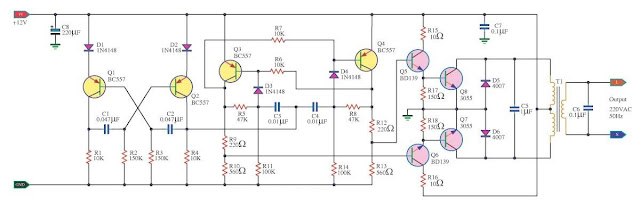
Simple 100W Inverter 12V to 220V Circuit Diagram

How to Build a100W Inverter 12V to 220V Circuit Diagram. When use the electric appliances that want 220V AC 50HZ, which have small-sized about 100Watt not exceed. By when you apply outside home, as a result have to have Mini power inverter about 100Watt, perform modify from work electricity forces of battery 12V give tall fair the work. 

100W Inverter 12V to 220V Circuit Diagram
 
100W Inverter 12V to 220V Circuit Diagram
 If you are New user electronics or want to economize or want to build electronics project use by oneself. I begs for to advise this circuit , because it uses , transistor number BC557 or the number replaces, perform oscillator generator. Then have power transistor 2N3055 numbers perform to drive coil transformer for converter voltage give tall go up 220V AC 50HZ at the electric power about 100 watt not exceed. When apply to transformer about 2A-3A. Picture circuit detail and like model PCB Board.

 PCB


Sourced By www.circuitsstream.blogspot.com
Read more

Friday, September 19, 2014

1 5V Battery to 5V Voltage Converter Circuit Diagram

This is a Simple 1.5V Battery to 5V Voltage Converter Circuit Diagram. Stable and secure 5V DC (at 200mA max) from an ordinary 1.5V AA sized cell. At the heart of this circuit is IC1 MAX756 from Maxim, which is a CMOS step-up DC-DC switching regulator for small, low input voltage or battery-powered systems.
 

Simple 1.5V Battery to 5V Voltage Converter Circuit Diagram

Simple 1.5V Battery to 5V Voltage Converter Circuit Diagram
MAX756 accepts a positive input voltage down to 0.7V and converts it to a higher pin selectable output voltage of 5V (or 3.3V). Typical full-load efficiency for the this IC is greater than 87%. Max756 combine a switch-mode regulator with an N-channel MOSFET, precision voltage reference, and power-fail detector in a single monolithic device. The MOSFET is a “sense-FET” type for best efficiency, and has a very low gate threshold voltage to ensure start-up under low-battery voltage conditions (1.1V typ).
The circuit can be easily wired on a very small rectangular common PCB.All connections should be kept as short as possible. If available,try to add a good quality 8 pin DIP socket for IC1. Note that the power inductor’s (L1) DC resistance significantly affects efficiency. For highest efficiency, limit L1’s DC resistance to 0.03 Ohm or less. A thru-hole type standard power inductor can be used. Similarly, the ESR of all capacitors (bypass and filter) affects circuit efficiency. Best performance is obtained by using specialized low-ESR capacitors.
Read more

Simple 500W 12V to 220V Inverter

500W 12V to 220V Inverter Circuit Diagram

500W 12V to 220V Inverter Circuit Diagram
 
This is a 500W DC-to-AC inverter circuit diagram which produces an AC output at line frequency and voltage. 12VDC to 220V 50Hz inverter circuit will power 220V or 110V appliances from 12V car battery. The circuit is easy to make and is low cost. Use proper transformer. The output (in watts) is up to you by selecting different power rating transformer and power transistor rating. If you load electronic device which require 120V AC, then use transformer with 120V in output.
Read more

500W Mos Fet Power Inverter from 12V to 110V 220V

 500W Mos-Fet Power Inverter from 12V to 110V/220V

 500W Mos-Fet Power Inverter from 12V to 110V/220V

500W Mos-Fet Power Inverter from 12V to 110V/220V

This circuit will provide a very stable "Square Wave" Output Voltage. Frequency of operation is determined by a pot and is normally set to 60 Hz. Various "off the shelf" transformers can be used. Or Custom wind your own FOR BEST RESULTS. Additional MosFets can be paralleled for higher power. It is recommended to Have a "Fuse" in the Power Line and to always have a "Load connected", while power is being applied. The Fuse should be rated at 32 volts and should be approximately 10 Amps per 100 watts of output. The Power leads must be heavy enough wire to handle this High Current Draw!
Read more

Whistle to Call Dogs Dog Caller Circuit Diagram

Dog trainers use a whistle to call dogs. But why blow that irritating, loud whistle when the dog can hear a sound inaudible to the humans? We the humans can hear up to 20 kHz, but dogs can hear ultrasound (sound ranging between 20 and 30 kHz) also. Here’s a circuit that generates 21 to 22 kHz (frequencies just above the audible range), so it can be used to call your pets by generating ultrasonic sound.

Whistle to Call Dogs Dog Caller Circuit Diagram

Whistle to Call Dogs Dog Caller Circuit Diagram


IC 555 is used as an oscillator. By adjusting the preset, ultrasonic sound of 21-22kHz frequency can be generated. Whistle effectiveness depends on the speaker used. Use of a low-wattage tweeter is recommended. (Don’t use an ultrasonic transducer, because it is designed for 40 kHz only.)

The circuit works off 9V. For portability, use a 9V PP3 battery and house the unit inside a pocket radio cabinet.

Author: Pradeep G  www.electronicsforu.com
Read more

DC13 8V to DC250V Inverter Circuit Diagram

DC13.8V to DC250V Inverter Circuit Diagram

DC13.8V to DC250V Inverter Circuit

I have done a lot of work with valves in recent years. For me valves have many advantages, least of all the price; since they are now "obsolete" it is quite easy to get hold of them for next to nothing at rallys and junk sales. I recently purchased a couple of hundred battery valves for less than SEK1 (US$ 0.15) each. The biggest problem with valves is the PSU needed to provide +250 vDC and 6.3 vAC for the filaments. The transformers are no-longer available at a reasonable price, but a pair of 12v-6v-0v-6v-12v mains transformers will do the job just as well. For portable use only one transformer is required together with a pair of power transistors such as 2N3055 etc.
Read more