Showing posts with label power. Show all posts

Wednesday, November 19, 2014

Audio Power Amplifier LM3886

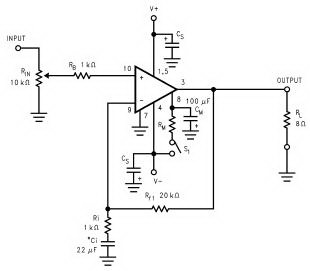
Audio Power Amplifier is an important part in the reproduction of sound in a sound system. Audio Power Amplifier LM 3886 with power IC Audio Power Amplifier is a highly capable and able to produce 68 Watts with power rata2 4Ohm load and capable of producing power 38 Watt with 8Ohm load. With good sound reproduction capabilities of 20Hz-20kHz is also included on this LM3886 Audio Power Amplifier. LM3886 Audio Power Amplifier is equipped with spike protection that will protect the output circuit from overvoltage, undervoltage, overloads, konrsleting power supply, thermal runawaydan peak temperature. Audio Power Amplifier LM3886 also features a noise reduction system which can keep the audio from the noise well.

Image of Basic Audio Power Amplifier Series LM3886

Audio


Audio Power Amplifier LM3886

Feature owned LM3886 Audio Power Amplifier

  • 68W cont. avg. output power into 4Ω at VCC = ± 28V
  • 38W cont. avg. output power into 8Ω at VCC = ± 28V
  • 50W cont. avg. output power into 8Ω at VCC = ± 35V
  • 135W instantaneous peak output power capability
  • Signal-to-Noise Ratio ≥ 92dB
  • An input mute function
  • Output protection from a short to ground or to the supplies via internal current limiting circuitry
  • Output over-voltage protection against transients from inductive loads
  • Supply under-voltage protection, not allowing internal biasing to occur Pls | VEE | + | VCC | ≤ 12V, Thus eliminating turn-on and turn-off transients
  • 11-lead TO-220 package
  • Wide supply range 20V - 94V
  • Application of Audio Power Amplifier LM3886
  • Stereo audio system
  • Active Speaker
  • High End Audio Power TV
  • Suround Power Amplifier
Read more

Tuesday, November 18, 2014

1000 Watt Power Amplifier

Power amplifier has up to 1000 Watt power, this circuit made one channel only so if you want to create a stereo in it must be made one again, actually this is more suitable power amplifier in use for Sound System or outdoor, so if only in use for the house I think is less suitable.
Maybe youve seen or even have an active speaker and there is written 1500 watts PMPO (Peak Music Power Output), make no mistake this is different from Power Amplifier Active Speaker, I often dismantle such Active Speaker in it only a power with power no more than 150 watts by using the transformer 2-3 Ampere. PMPO is not a real power which is issued by the Power Amplifier, but counting all the speakers that there is, for example: if there are 5 pieces of speakers on each channel and each speaker has a power of 10 W then it is 100 W PMPO.
1000W Power Amplifier schematics
Part List 1000W amplifier
While this 1000 Watt Power Amplifier minimal use transformer 20 Ampere. And the output of Power Amplifier DC voltage contains approximately 63 volts, with currents and voltages of this magnitude, this 1000 Watt Power Amplifier will not hesitate hesitate to destroy your woofer speakers to connect. To overcome that then before the speaker on connects to 1000 Watt Power Amplifier must be in pairs Speaker Protector.

Actually if you want to create a Power Amplifier with great power does not have to make a Power Amplifier with great power. Example: you want to create a Power Amplifier with 10 000 Watt power. You do not have to assemble a Power Amplifier with power of 10,000 watts, but you assemble the power Power Amplifier Small but many, such as you assemble the Power Amplifier with 1000 Watts of power for as many as 10 pieces, it will produce 10 000 Watt Power Amplifier helpless.

Circuit uses power transistors pair of 5 x 5 x 2SA1216 and 2SC2922 and 2SC1583 use a differential amplifier that actually contains 2 pieces of transistors that are in containers together. Why use such built-in amplifier differental tujuanya so identical / similar, could have uses 2 separate transistors but can result in amplifier so it is not symmetrical.

Tips combining speaker.

To get the speakers with great power combining techniques can be used in parallel series, combining each group of speakers should sepaker they will have the same impedance, the same type (Woofer, Mid Range or tweeter) and the same power. Number of merging these speakers should consists of 4 , 9, 16 ff, see picture
Speaker wiring


Example: The number of speakers have 4 pieces each of its 200 Watt power generated will be a speaker at = 200 x 4 = 800 Watt. If there are 9 speakers 200 W then the result = 9 x 200 W = 1800 Watt.
Read more

Subwoofer power amplifier IC OPA541BM

Subwoofer power amplifier circuit based on IC OPA541BM very suitable for use in subwoofer speakers, these amplifiers possess excellence in sound issud because the sound is very clear and issued in accordance with subwoofer speakers in a low tone.
Subwoofer power amplifier IC OPA541BM Circuit

Read more

Monday, November 17, 2014

LM4651 and LM4652 170W power amplifier

170 Watt power amplifier is a power amplifier that is built by IC LM4651 and LM4652. Part of this power amplifier driver using the LM4651 IC designed specifically for the purpose of the class AB amplifier driver with short circuit protection feature, containing under voltage, thermal shutdown protection and standby functions. Section 170 Watt power amplifier using LM4651 IC with a MOSFET power amplifier is equipped with temperature sensors that will be used by IC LM4651 as controlnya thermal signal. IC IC LM4651 and LM4652 are designed specifically to each other in pairs to create a class AB power amplifier with protection features are detailed. Detailed series of 170 Watt power amplifier can be seen in thethe following figure .

LM4651

Power amplifier circuit requires supply voltages +22 V DC symmetrical 0-22V. Power Amplifier with IC LM4651 and LM4652 are often used in portable HiFi systems such as powered speakers, power subwoofer and car audio power Booter. D1, D2, D3 and D4 in series 170 watt power amplifier with LM4651 and LM4652 is a 22V zener diode.
Read more

Monday, November 3, 2014

Friday, October 17, 2014

IC 741 2N3055 Power Amp OCL 70w

Younger brothers and sisters a student takes an interest to build electronics project sends a teacher. I then choose this circuit , because build easy be valuable certainly. It is Main Power Amplifier Circuit 70Watt RMS sizes are model OCL Class AB. Use pillar equipment be IC 741 and Transistor 2N3055,MJ2955 a little this equipment circuit. If friends want get electric tall power about 70Watt should use Voltage Supply +38V , and -38V. The usability should fine VR1 be appropriate. Request a friend has fun to listen the music from Amp Circuit , please sir.

Read more

Variable DC Power Supply Circuit Diagram

This project provides the schematic & the parts list needed to construct a simple DC Power Supply from an input power supply of 7-20 V AC or 7-30V DC. This project will come in handy in case you use plenty of batteries for your basic electronics project.

Two DC voltage outputs are available; is a fixed regulated 5V for TTL use. The other output is variable from 5V upwards. The maximum output voltage depends on the input voltage. The specified maximum input DC voltage to the regulator is 35V. The maximum input voltage must be two volts higher than the regulated output voltage.

Variable DC Power Supply Circuit Diagram


Variable


The DC Power Supply circuit is based around the 7805 voltage regulator. Its only three connections input, output & ground & it provides a fixed output. The last digits of the part number specify the output voltage, e g. 05, 06, 08, ten, 12,15, 18, or 24. The 7800 series provides up to one amp load current & has on-chip circuitry to close down the regulator if any attempt is made to operate it outside its safe operating area.It can be seen that theres in fact separate circuits in this power supply. 7805 is directly connected as a fixed 5V regulator. The second 7805 has a resistor divider network on the output. A variable 500 ohm potentiometer is used to vary the output voltage from a maximum of 5V up to the maximum DC voltage depending on the input voltage. It will be about 2V below the input DC voltage.

The capacitor across the output improves transient response. The giant capacitor across the input is a filter capacitor to help smooth out ripple in the rectified AC voltage. The larger the filter capacitor the lower the ripple.

For tiny applications the heat sinks wont be needed. The tab on the regulator will dissipate 2W at 25 o C in air. (This is equivalent, for example, to an input voltage of 9V, an output of 5V & drawing 500 m A.) However, as your projects get bigger they will draw more current from the power supply and the regulators will operate at a higher temperature and a heat sink will be needed. You can basically add voltage & current meters to it and put it in to an appropriate plastic case connected to a transformer.

Trouble Shooting Procedure

An LED has been put in to the output of the fixed 5V regulator to indicate that the circuit is working. Poor soldering is the most likely reason that the circuit does not work. Check that all the soldering is done properly. Check that all parts are in their correct position on the PCB. Other items to check are to make sure that the regulators, electrolytic capacitor & bridge rectifier are inserted in the correct orientation.
Read more

Thursday, October 16, 2014

Constructing your own Dual Power Supply Rise

Many times the hobbyist desires to have a simple, dual power supply for a project. Existing power supplies may be large either in power output or physical size. a simple Dual Power Supply is necessary.For most non-critical applications the best & simplest choice for a voltage regulator is the 3-terminal type.The three terminals are input, ground & output.

The 78xx & 79xx series can provide up to 1A load current & it have on chip circuitry to prevent damage in the event of over heating or excessive current. That is, the chip basically shuts down than blowing out. These regulators are cheap, simple to make use of, & they make it practical to design a method with plenty of P C Bs in which an unregulated supply is brought in & regulation is done locally on each circuit board.

This Dual Power Supply project provides a dual power supply. With the appropriate choice of transformer & 3-terminal voltage regulator pairs you can basically build a tiny power supply delivering up to amp at +/- 5V, +/- 9V, +/- 12V, +/-15V or +/-18V. You require to provide the middle tapped transformer and the 3-terminal pair of regulators you require:7805 & 7905, 7809 & 7909, 7812 & 7912, 7815 & 7915or 7818 & 7918.

The user must pick the pair they needs for his particular application.

Note that the + & - regulators do not must be matched: you can for example, use a +5v & -9V pair. However,the positive regulator must be a 78xx regulator, & the negative a 79xx. They have built in plenty of safety in to this project so it ought to give plenty of years of continuous service.

Transformer
This Dual Power Supply design makes use of a full wave bridge rectifier coupled with a centre-tapped transformer. A transformer with a power output rated at at least 7VA ought to be used. The 7VA rating means that the maximum current which can be delivered without overheating will be around 390mA for the 9V+9V tap; 290mA for the 12V+12V and 230mA for the 15V+15V. If the transformer is rated by output RMS-current then the worth ought to be divided by one.2 to get the current which can be supplied. For example, in this case a 1A RMS can deliver 1/(one.2) or 830mA.

Rectifier
They use an epoxy-packaged four amp bridge rectifier with at least a peak reverse voltage of 200V. (Note the part numbers of bridge rectifiers are not standardised so the number are different from different manufacturers.) For safety the diode voltage rating ought to be at least to times that of the transformers secondary voltage. The current rating of the diodes ought to be two times the maximum load current that will be drawn.

Filter Capacitor
The purpose of the filter capacitor is to smooth out the ripple in the rectified AC voltage. Theres dual amount of ripple is determined by the worth of the filer capacitor: the larger the worth the smaller the ripple.The two,200uF is an appropriate value for all the voltages generated using this project. The other consideration in choosing the correct capacitor is its voltage rating. The working voltage of the capacitor has to be greater than the peak output voltage of the rectifier. For an 18V supply the peak output voltage is one.4 x 18V, or 25V. So they have selected a 35V rated capacitor.

Regulators
The unregulated input voltage must always be higher than the regulators output voltage by at least 3V in order for it to work. If the input/output voltage difference is greater than 3V then the excess potential must be dissipated as heat. Without a heat sink three terminal regulators can dissipate about two watts. A simple calculation of the voltage differential times the current drawn will give the watts to be dissipated. Over two watts a heat sink must be provided. If not then the regulator will automatically turn off if the internal temperature reaches 150oC. For safety it is always best to make use of a small heat sink even in case you do not think you will need.

Stability
C4 & C5 improve the regulators ability to react to sudden changes in load current & to prevent uncontrolled oscillations.

Decoupling
The mono block capacitor C2 & C6 across the output provides high frequency decoupling which keep the impedance low at high frequencies.

LED
Two LEDs are provided to show when the output regulated power is online. You do not must make use of the LEDs in the event you do not require to. However, the LED on the negative side of the circuit does provide a maximum load to the 79xx regulator which they found necessary in the coursework of testing. The negative 3-pin regulators did not like a zero load situation. They have provided a 470R/0.5W resistors as the current limiting resistors for the LEDs.

Diode Protection
These protect chiefly against any back emf which may come back in to the power supply when it supplies power to inductive lots. They also provide additional short circuit protection in the case that the positive output is connected by accident to the negative output. If this happened the usual current limiting shutdown in each regulator may not work as intended. The diodes will short circuit in this case & protect the two regulators.

Dual Power Supply Schematic Diagram


Dual

Read more

Thursday, October 9, 2014

LA47536 bassed high power car audio amplifier circuit with explanation


This car audio amplifier circuit is based on LA47536 audio amplifier integrated circuit designed by Sanyo . This audio amplifier circuit is specially designed for car audio power amplifiers and . LA47536 car audio amplifier IC has four output channels and is capable to provide a maximum output power of 45 watts on each channel on a 4 ohms load with 10% THD .
The LA47536 includes almost all the functions required for car audio use, including a standby switch, muting function, and various protections (output pin-to-VCC short , output pin-to-GND short ,load short , over voltage , thermal shut down circuit ). It also provides a self-diagnosis function (output offset detection).

Also this audio amplifier IC has a voltage gain of 32 dB and a self-diagnosis function that detects the output offset . For powering this car audio amplifier circuit you will need a 14. 4 volts DC , or you can use the car battery ( if you will use it for car ) .
Using a 12 volts Dc power supply , the output power will be a little low , but the distortion ( THD ) will be very low .

Read more

Sunday, October 5, 2014

uninterrupted power supply circuit diagram

uninterrupted power supply schematic

The circuit drawn pertains to a regular industrial UPS (Uninterruptible Power Provide), which shows how the batteries get control throughout an outage in electrical provide or variation beyond the normal limits with the voltage line, without having disruption on the operation supplying a steady regulated output (five Volts by LM7805) and an unregulated supply (twelve Volts).

The input to the primary winding with the transformer (TR1) is 240V. The secondary winding may be raised as much as 15 Volts in case the worth is at least twelve Volts operating two amp. The fuse (FS1) acts as being a mini circuit breaker for defense versus short circuits, or a defective battery cell in actual fact. The presence of electrical power will cause the LED one to light. The light of LED will set off upon power outage along with the UPS battery will consider more than

The circuit was designed to present alot more versatile pattern wherein it can be customized by making use of numerous regulators and batteries to generate regulated and unregulated voltages. Making use of two 12 Volt batteries in sequence and a good input 7815 regulator, can control a 15V provide.
Read more

Thursday, October 2, 2014

Adjustable Voltage Current Power Supply Circuit Using IC L200

  1.  IC2 is connected as a differential amplifier and compares the signals at its two inputs.
  2. Referring to the circuit diagram: the input comprises a mains switch, fuse, transformer, bridge rectifier and smoothing capacitor (C2).
  3. The difference between the inputs is the voltage drop across current’ sensor R4. This IC feeds the current sensing input (pin 2) of the L200.
  4. P1 in the feedback loop of the 741 is used to vary the output current of the circuit. IC1 must be mounted on a suitable heat sink as it dissipates nearly all the power of the circuit.
  5. The reference level output from I pin 4 of IC1 goes to the voltage divider made up of R5 and P2 (this pot sets the value of the output voltage).
  6. The power supply can quite easily be built into a case and a voltmeter and ammeter mounted on the front panel. ln view of the accuracy of the circuit these should ideally be digital meters, but virtually any type will do.
  7. If you compare the expense and the rating of this power supply you will get a surprise, because the output voltage and current are fully adjustable between O. . . 18 V and 0 . . . 1.8 A respectively and costs have still been kept very reasonable.
  8. Diode D5 and capacitor C1 produce a negative auxiliary voltage, which is stabilized by zener diode D6 and capacitor C4.
  9. All this is necessary to enable the output voltage to be adjusted down to zero volts. During the construction of this part of the circuit bear in mind that the positive lead of electrolytic capacitor C4 is connected to earth! Regulation is provided by IC1 and IC2. Capacitor C3 suppresses any residual transients at the input of lC1 and it should therefore be connected as closely as possible to IC1 similarly C4 and IC2).
  10. The negative voltage provides the negative supply for the two ICs. 

Read more

Wednesday, September 24, 2014

Dual Power Supply 78xx 79xx

Many times the hobbyist wants to have a simple, dual power supply for a project. Existing powersupplies may be too big either in power output or physical size. Just a simple Dual Power Supply is required.For most non-critical applications the best and simplest choice for a voltage regulator is the 3-terminal type.The 3 terminals are input, ground and output.

The 78xx & 79xx series can provide up to 1A load current and it have onchip circuitry to prevent damage in the event of over heating or excessive current. That is, the chip simply shuts down rather than blowing out. These regulators are inexpensive, easy to use, and they make it practical to design a system with many PCBs in which an unregulated supply is brought in and regulation is done locally on each circuit board.
Circuit diagram:
Dual_Power_Supply_Schematic Circuit diagram
Dual Power Supply Schematic Circuit diagram
This Dual Power Supply project provides a dual power supply. With the appropriate choice of transformer and 3-terminal voltageregulator pairs you can easily build a small power supply delivering up to one amp at +/- 5V, +/- 9V, +/- 12V, +/-15V or +/-18V. You have to provide the centre tapped transformer and the 3-terminal pair of regulators you want:7805 & 7905, 7809 & 7909, 7812 & 7912, 7815 & 7915or 7818 & 7918.
Note that the + and - regulators do not have to be matched: you can for example, use a +5v and -9V pair. However,the positive regulator must be a 78xx regulator, and the negative a 79xx one. We have built in plenty of safety into this project so it should give many years of continuous service.  The user must choose the pair he needs for his particular application.
Parts :
Dual_Power_Supply_Parts list
Transformer
This Dual Power Supply design uses a full wave bridge rectifier coupled with a centre-tapped transformer. A transformer with a power output rated at at least 7VA should be used. The 7VA rating means that the maximum current which can be delivered without overheating will be around 390mA for the 9V+9V tap; 290mA for the 12V+12V and 230mA for the 15V+15V. If the transformer is rated by output RMS-current then the value should be divided by 1.2 to get the current which can be supplied. For example, in this case a 1A RMS can deliver 1/(1.2) or 830mA.
Rectifier
We use an epoxy-packaged 4 amp bridge rectifier with at least a peak reverse voltage of 200V. (Note the part numbers of bridge rectifiers are not standardised so the number are different from different manufacturers.) For safety the diode voltage rating should be at least three to four times that of the transformers secondary voltage. The current rating of the diodes should be twice the maximum load current that will be drawn.
Filter Capacitor
The purpose of the filter capacitor is to smooth out the ripple in the rectified AC voltage. Theresidual amount of ripple is determined by the value of the filer capacitor: the larger the value the smaller the ripple.The 2,200uF is a suitable value for all the voltages generated using this project. The other consideration inchoosing the correct capacitor is its voltage rating. The working voltage of the capacitor has to be greater than thepeak output voltage of the rectifier. For an 18V supply the peak output voltage is 1.4 x 18V, or 25V. So we havechosen a 35V rated capacitor.
Regulators
The unregulated input voltage must always be higher than the regulators output voltage by at least 3V inorder for it to work. If the input/output voltage difference is greater than 3V then the excess potential must bedissipated as heat. Without a heatsink 3 terminal regulators candissipate about 2 watts. A simple calculation of the voltage differential times the current drawn will give the watts tobe dissipated. Over 2 watts a heatsink must be provided. If not then the regulator will automatically turn off if theinternal temperature reaches 150oC. For safety it is always best to use a small heatsink even if you do not think youwill need one.
Stability
C4 & C5 improve the regulators ability to react to sudden changes in load current and to preventuncontrolled oscillations.
Decoupling
The monoblok capacitor C2 & C6 across the output provides high frequency decoupling which keepsthe impedence low at high frequencies.
LED
Two LEDs are provided to show when the output regulated power is on-line. You do not have to use theLEDs if you do not want to. However, the LED on the negative side of the circuit does provide a minimum load tothe 79xx regulator which we found necessary during testing. The negative 3-pin regulators did not like a zeroloadsituation. We have provided a 470R/0.5W resistors as the current limiting resistors for the LEDs.
Diode Protection
These protect mainly against any back emf which may come back into the power supply when itsupplies power to inductive loads. They also provide additional short circuit protection in the case that thepositive output is connected by accident to the negative output. If this happened the usual current limiting shutdownin each regulator may not work as intended. The diodes will short circuit in this case and protect the 2 regulators. 
Read more

Supply Variable 1V to 9V Circuit using Power PC

This is a variable power supply which converts an input voltage from 12V SMPS / PSU a desktop computer, to an output voltage from 1.25 to 9 volts. This converter will be very useful for electronics hobbyists. 

The circuit uses a LM317T regulator IC that can reach up to 1 ampere, the diode D1 protects against polarity reversal and the diode D2 keeps the output voltage from the input voltage increases when an inductive or capacitive load is connected to the output.Similarly, the capacitor C3 removes any residual noise of the line regulates the voltage potentiometer VR1.


Supply Variable 1V to 9V  using Power PC Circuit Diagram

Supply Variable 1V to 9V Circuit using Power PC

Read more

1 5 35 Volt DC Regulated Power Supply

Here is the circuit diagram of regulated power supply. It is a small power supply that provides a regulated voltage, adjustable between 1.5 and 35 volts at 1 ampere. This circuit is ready to use, you just need to add a suitable transformer. This circuit is thermal overload protected because the current limiter and thermal overload protection are included in the IC.

Picture of the circuit:
 1A 1.5 volt to 35 volt dc Regulated Power Supply Circuit Schematic
1A Regulated Power Supply Circuit Schematic
 
Circuit diagram:
 1A 1.5 volt to 35 volt dc Regulated Power Supply Circuit Diagram
1A Regulated Power Supply Circuit Diagram
 
Transformer selection chart:
  Transformer Selection Chart for 1A 1.5 volt to 35 volt dc Regulated Power Supply Circuit Diagram
Transformer selection Guide-Table For Power Supply
 
Parts:
IC = LM317
P1 = 4.7K
R1 = 120R
C1 = 100nF - 63V
C2 = 1uF - 35V
C3 = 10uF - 35V
C4 = 2200uF - 35V
D1-D4 = 1N4007

Features:
  • Just add a suitable transformer (see table)
  • Great to power your projects and save money on batteries
  • Suitable as an adjustable power supply for experiments
  • Control DC motors, low voltage light bulbs, …
Specs :
  • Preset any voltage between 1.5 and 35V
  • Very low ripple (80dB rejection)
  • Short-circuit, thermal and overload protection
  • Max input voltage : 28VAC or 40VDC
  • Max dissipation : 15W (with heatsink)
  • Dimensions : 52x52mm (2.1” x 2.1”)
Technical Specs
  • Input Voltage = 40Vdc max Transformer
  • Output Voltage = 1.5V to 35Vdc
  • Output Current = 1.5 Amps max.
  • Power Dissipation = 15W max (cooled)
Note:
  • It has not to be cooled if used for small powers. 28 Volt AC max is allowed for the input voltage.
Read more

Tuesday, September 23, 2014

Mosfet Power Inverter 1000 Watt

Mosfet Power Inverter 1000 Watt

This power inverter circuit will provide a very stable “Square Wave” Output Voltage. Frequency of operation is determined by a pot and is normally set to 60 Hz. Various “off the shelf” transformers can be used. Or Custom wind your own for best results.

Additional MosFets can be paralleled for higher power. It is recommended to Have a “Fuse” in the Power Line and to always have a “Load connected”, while power is being applied. The Fuse should be rated at 32 volts and should be aproximately 10 Amps per 100 watts of output. The Power leads must be heavy enough wire to handle this High Current Draw! appropriate Heat Sinks Should be used on the RFP50N06 Fets. These Fets are rated at 50 Amps and 60 Volts. Other types of Mosfets can be substituted if you wish.

There ARE Limitations! I have had numerous requests for an Inverter for 1000 watts and Even MORE. Sorry I Don’t feel this is Practical. At 1000 Watts and operating from a 12 Volt Source, the Input Current will be close to 100 AMPS. That would Require a HUGH Size of a Primary Wire.

1000 Watt Mosfet Power Inverter 

Read more

100 Watt Power Amplifier Circuit With IC TDA7294

Power Amplifier TDA7294 is a power amplifier with IC Power Amplifier is a mono 100W Class AB operation of OCL.

The power supply circuit. Positive, negative, and ground. Usually, we use the power supply circuit to + /-25V to + /-35V at 100W RMS will be used to heat sufficiently.

After many members have already made the TDA7294 as I know, with a sound quality that is the very gods or Hi-End itself.


Several days before the member’s PM to me saying that I had an amplifier using IC TDA7294 to have more of the same. Higher power. And low heat.

Achieved by increasing the voltage raising circuit For the more, it means high power and high heat up. Today I have come across. I use IC TDA7294 circuit at the time.

In-Home Use amplifier circuit is a Class G amplifier with low power consumption, resulting in the loss of a 20V DC power less.

And when you’re driving a high-power random access is party to a rhythm. Principles to do it. I took out a membership you can do is try to build up a bit.

We provides PCB both top and bottom side for you.
 
Sourced By : Circuitsstream
Read more

TL594 12V DC Switch Mode Power Supply Circuit Diagram

Basic Of Switch Mode Power Supply
In recent years, the use of switch mode power supply (SMPS) has become more comon as more applications demand for greater power eficiency. It makes use of semiconductor (mostly MOSFET) fast switches to switch DC input that has been rectified at high frequency. The advantages of high frequency switching are that it reduces the size of inductor, capacitors & transformer used. Other advantages of switching power supply over linear power supply are :

1) High Efficiency (up to 90% and above for nice design).
2) Output can be higher than input.
3) Able to operate over a variety of input power supply.
4) Able to have over output.

The setback of using SMPS compared to linear power supply is that it generates electrical noise which contributes to electromagnetic compatibility design issues & more part count.

Buck Converter SMPS
The SMPS circuit below from Power Integration makes use of LNK304 as its high frequency switch. Take note that this circuit is non isolated type which means that the output is not electrically isolated from the input & all testing ought to be completed using an isolation transformer to provide the AC line input to the board.

Make positive that you have electrical safety knowledge & experience before you embark on doing this project.

12V DC Switch Mode Power Supply Circuit Diagram

12V DC Switch Mode Power Supply Circuit Diagram


Read more

Monday, September 22, 2014

3 30V 3A Adjustable Regulated DC Power Supply circuit and explanation


This power supply is meant as an auxiliary or as a permanent power supply for all common circuits based on a stabilized DC voltage between 3 and 30V provided that the consumption does not exceed 3A. Of course this power supply unit can also be used for other purposes. Be replacing the trimmer by a potentiometer, it may even be used as an adjustable power supply unit. A good quality heatsink must be used.
[...]
Parts list:
R1 = 8.2K
R2 = 2.2K
R3 = 680R
R4 = 1K
R5 = 82K
R6 = 0.18R/5W
C1 = 470p
C2 = 100nF-63V
C3 = 100nF-63V
C4 = 100uF-63V
C5 = 10KuF-60V
D1-D6 = 6.6A
Q1 = MJ3001 (Darligton)
IC1 = UA723D

Specifications:
* Overload protected
* Sshort-circuit stable
* Output current: max. 3A
* Output ripple voltage: 0.5mV
* Output voltage: adjustable from 3 to 30V, stabilized
* Input voltage: 9 to 30V AC (depending on the desired output voltage)

Source: http://www.extremecircuits.net/2010/02/3-30v-3a-adjustable-regulated-dc-power.html

Read more

Sunday, September 21, 2014

Variable DC Power Supply LM317

Variable DC Power Supply LM317

This DC power supply circuit is adjustable using IC Voltage Regulator LM317. LM317 is a versatile and highly efficient 1.2-37V voltage regulator that can provide up to 1.5A of current with a large heat sink. Its ideal for just about any application. This was my first workbench power supply and I still use it.


Since LM317 is protected against short-circuit, no fuse is necessary. Thanks to automatic thermal shutdown, it will turn off if heating excessively. All in all, a very powerful (and affordable!) package, indeed.

Although voltage regulator LM317 is capable of delivering up to 37V, the DC power supply output circuit here is limited to 25V for the sake of safety and simplicity. Any higher output voltage would require additional components and a larger heat sink.

Make sure that the input voltage is at least a couple of Volts higher than the desired output. Its ok to use a trimpot if youre building a fixed-voltage supply.

Problems:
Follow all the safety precautions when working with mains voltage. Insulate all connections on the transformer.

Possible uses:
Variable workbench power supply, fixed-voltage supply. Just about any possible application when no more than 1.5A is necessary.
Read more