Showing posts with label audio. Show all posts

Wednesday, November 19, 2014

Audio Power Amplifier LM3886

Audio Power Amplifier is an important part in the reproduction of sound in a sound system. Audio Power Amplifier LM 3886 with power IC Audio Power Amplifier is a highly capable and able to produce 68 Watts with power rata2 4Ohm load and capable of producing power 38 Watt with 8Ohm load. With good sound reproduction capabilities of 20Hz-20kHz is also included on this LM3886 Audio Power Amplifier. LM3886 Audio Power Amplifier is equipped with spike protection that will protect the output circuit from overvoltage, undervoltage, overloads, konrsleting power supply, thermal runawaydan peak temperature. Audio Power Amplifier LM3886 also features a noise reduction system which can keep the audio from the noise well.

Image of Basic Audio Power Amplifier Series LM3886

Audio


Audio Power Amplifier LM3886

Feature owned LM3886 Audio Power Amplifier

  • 68W cont. avg. output power into 4Ω at VCC = ± 28V
  • 38W cont. avg. output power into 8Ω at VCC = ± 28V
  • 50W cont. avg. output power into 8Ω at VCC = ± 35V
  • 135W instantaneous peak output power capability
  • Signal-to-Noise Ratio ≥ 92dB
  • An input mute function
  • Output protection from a short to ground or to the supplies via internal current limiting circuitry
  • Output over-voltage protection against transients from inductive loads
  • Supply under-voltage protection, not allowing internal biasing to occur Pls | VEE | + | VCC | ≤ 12V, Thus eliminating turn-on and turn-off transients
  • 11-lead TO-220 package
  • Wide supply range 20V - 94V
  • Application of Audio Power Amplifier LM3886
  • Stereo audio system
  • Active Speaker
  • High End Audio Power TV
  • Suround Power Amplifier
Read more

Monday, November 3, 2014

Sunday, November 2, 2014

Tuesday, October 28, 2014

Alpine Audio Amplifier 500 Watt RMS

Alpine
Alpine
Alpines Amplifier to chain is a good series of normal-grade amplifiers. They arent lofty terminate, but they value is isnt "high end" either. They are efficient and control well with vehicles with the purpose of dont exactly say a bundle of further amps free in support of powering amplifiers. I run an MRP-M500 and an MRP-F300 arrived my Honda Fit and they both supply me with capable, clean power not including taxing my cars electrical usage.

In my system, the M500 is powering a 12" subwoofer in a insignificant, sealed box. with the purpose ofs not exactly a formula meant for greatest extent deep shock, but the M500 does a major occupation pushing my subwoofer to its fullest budding. The classify-D circuitry makes the amp very efficient so with the purpose of it bidding effort well clothed in nearly all vehicles electrical systems.

The lone downside Ive found is to the EQ functions are relatively inadequate. You comprehend controls designed for hub frequency, crossover advantage, and low boost. It makes it a minute other intricate to get a smooth sound flanked by this amp and your four-channel amp. It presently takes longer than if in attendance were supplementary EQ controls. too, the low boost puts a definite crest voguish its frequency output so so as to the amplitude drops sour higher than and underneath the inside frequency. That earnings that if you like to step the greatest power output, your range is open to come to pass somewhat inadequate.

Overall, Im very glad with the M500. seeing that extended as youon the subject of not looking to power a massive, inefficient subwoofer, it be supposed to donate you a very smooth, musical sound.

MRP-M500 - Alpine Monoblock 500 Watt RMS Power Amplifier  :

Product Features

  • Mono subwoofer car amplifier
  • 300 watts RMS x 1 at 4 ohms (500 watts RMS x 1 at 2 ohms)
  • Class D amp with MOSFET power supply
  • 10-11/16"W x 2-7/16"H x 9-9/16"D

Technical Details

  • Brand Name: Alpine
  • Model: MRP-M500
  • Faceplate Type: Detachable
  • Device Type: Amplifier
  • MP3 player: N
  • Warranty: 1 year warranty

Read more

Saturday, October 25, 2014

Output Relay Delay Audio Amplifier Diagram Circuit

This is a simple circuit which I built to one of my audio amplifier projects to control the speaker output relay. The purpose of this circuit is to control the relay which turns on the speaker output relay in the audio amplifier. The idea of the circuit is wait around 5 seconds ofter the power up until the speakers are switched to the amplifier output to avoid annoying "thump" sound from the speakers. Another feature of this circuit is that is disconnects the speaker immediately when the power in the amplifier is cut off, so avoiding sometimes nasty sounds when you turn the equipments off.

Circuit diagram:
Audio Amplifier Output Relay Delay Circuit Diagram
Component list
C1 = 100 uF 40V electrolytic
C2 = 100 uF 40V electrolytic
D1 = 1N4007
D2 = 1N4148
Q1 = BC547
R1 = 33 kohm 0.25W
R2 = 2.2 kohm 0.25W
RELAY 24V DC relay, coil resistance >300 ohm

Circuit operation:

Then power is applied to the power input of the circuit, the positive phase of AC voltage charges C1. Then C2 starts to charge slowly through R1. When the voltage in C2 rises, the emitter output voltage of Q1 rises together with voltage on C2. When the output voltage of Q2 is high enough (typically around 16..20V) the relay goes to on state and the relay witches connect the speakers to the amplifier output. It takes typically around 5 seconds after power up until the relay starts to conduct (at absolute time depends on the size of C2, relay voltage and circuit input voltage). When the power is switched off, C1 will loose its energy quite quickly. Also C2 will be charged quite quickly through R2. In less than 0.5 seconds the speakers are disconnected from the amplifier output.

Notes on the circuit:
This circuit is not the most accurate and elegant design, but it has worked nicely in my small home-built PA amplifier. This circuit can be also used in many other applications where a turn on delay of few seconds is needed. The delay time can be increased by using bigger C2 and decreased by using a smaller C2 value. Note that the delay is not very accurate because of simplicity of this circuit and large tolerance of typical electrolytic capacitors (can be -20%..+50% in some capacitors).
Author: Tomi Engdahl
Read more

Wednesday, October 15, 2014

Simple Phase Shift Meter for Audio Frequency Signal

Simple phase shift measurement can be done by squaring both the measured and the reference, then compute the difference of the two signals. The accuracy of the circuit shown in the schematic diagram  below is 1% UP to 2000 cps.

This circuit is used in computers and for high speed analog instrumentation. Negative value for zero phase shift is indicated by the zero center DC ammeter, zero for 90′ phase shift and some maximum value for 180′ phase shift.

 Phase-Shift Meter for Audio Frequency Signal Circuit Diagram

Simple

Read more

Thursday, October 9, 2014

LA47536 bassed high power car audio amplifier circuit with explanation


This car audio amplifier circuit is based on LA47536 audio amplifier integrated circuit designed by Sanyo . This audio amplifier circuit is specially designed for car audio power amplifiers and . LA47536 car audio amplifier IC has four output channels and is capable to provide a maximum output power of 45 watts on each channel on a 4 ohms load with 10% THD .
The LA47536 includes almost all the functions required for car audio use, including a standby switch, muting function, and various protections (output pin-to-VCC short , output pin-to-GND short ,load short , over voltage , thermal shut down circuit ). It also provides a self-diagnosis function (output offset detection).

Also this audio amplifier IC has a voltage gain of 32 dB and a self-diagnosis function that detects the output offset . For powering this car audio amplifier circuit you will need a 14. 4 volts DC , or you can use the car battery ( if you will use it for car ) .
Using a 12 volts Dc power supply , the output power will be a little low , but the distortion ( THD ) will be very low .

Read more

Friday, October 3, 2014

ICL8038 Audio Oscillator Circuit

ICL8038 is a monolithic waveform generator IC that can aftermath sine, aboveboard and triangular waveforms with actual little distortion. The abundance can be programmed from 0.001Hz to 300 KHz application alien timing capacitor and resistor. Abundance accentuation and across-the-board can be accomplished by application an alien voltage. Other appearance of the ICL8038 are top linearity, top akin outputs, accompanying sine, square, triangle beachcomber outputs, low alien locations count, top temperature adherence etc.

The alive of ICL8038 is as follows. The external timing capacitor is answerable and absolved application two centralized accepted sources. The aboriginal accepted antecedent is on all the time and additional accepted is switched ON and OFF application a flip-flop. Suppose the additional accepted antecedent is OFF and the aboriginal accepted antecedent is ON, afresh the capacitor C2 will be answerable with a connected accepted (i) and the voltage beyond C2 increases linearly with time. When the voltage alcove 2/3 accumulation voltage, authoritative cast bomb is triggered and the aboriginal accepted antecedent is activated. This accepted antecedent carries bifold the accepted (2i) authoritative the capacitor C2 is absolved with a accepted i and the voltage beyond it drops linearly with time. When this voltage alcove 1/3 accumulation voltage, the cast bomb is resetted to the antecedent action and the aeon is afresh again.

The circuit diagram accustomed aloft shows a capricious audio abundance oscillator application ICL8038. Such a ambit is actual advantageous while testing audio accompanying projects. The abundance ambit of this ambit is 20Hz to 20KHz. POT R6 can be acclimated for adjusting the abundance while POT R9 can be acclimated for adjusting the distortion. POT R4 can be acclimated for adjusting the assignment aeon while POT R7 can be acclimated for adverse the variations in assignment cycle. C2 is the alien timing capacitor and R5 is a cull up resistor.

Read more

Wednesday, September 24, 2014

Small Audio Amplifiers Using LM386 and NE5534

Many electronic projects require the use of a small audio amplifier. Be it a radio transceiver, a digital voice recorder, or an intercom, they all call for an audio amp that is small, cheap, and has enough power to provide adequate loudness to fill a room, without pretending to serve a disco! About one Watt RMS seems to be a convenient size, and this is also about the highest power that a simple amplifier fed from 12V can put into an 8 Ohm speaker. A very low saturation amplifier may go as high up as 2 Watt, but any higher power requires the use of a higher voltage power supply, lower speaker impedance, a bridge circuit, or a combination of those.

During my many years building electronic things I have needed small audio amps many times, and have pretty much standardized on a few IC solutions, first and and foremost the LM386, which is small, cheap, and very easy to use. But it does not produce high quality audio... For many applications, the advantages weigh more than the distortion and noise of this chip, so that I used it anyway. In other cases I used different chips, which perform better but need more complex circuits. Often these chips were no longer available the next time I needed a small amplifier.

When I last upgraded my computer, I replaced the old and trusty Soundblaster AWE 32 by a Soundblaster Audigy. The new card is better in many regards, but while the old one had an internal audio power amplifier, the new one doesnt! Thats bad news, because I have some pretty decent speakers for the PC, which are fully passive. So, I built a little stereo amp using two LM386 chips and installed it inside the computer, fed by the 12V available internally.

But then I wasnt satisfied. The LM386 might be suitable for "communication quality" audio, which is roughly the fidelity you get over a telephone, but for music its pretty poor! The distortion was awful. So, the day came when I decided to play a little more scientifically with small audio amps, looking for a way to get good performance with simple and inexpensive means.

I set up a test bench with a sine wave oscillator running at 1 kHz, an 8 Ohm speaker, 12V power supply, and the computer with the soundcard and Fast Fourier Transform software. One channel was connected to the oscillator together with the amplifier input, the other channel to the output and speaker. With this setup I measured the harmonic content of the audio signals. I did the tests at an output level of 0.1W, which is typical for moderately loud sound from a reasonably efficient speaker. Also, I used a music signal from a CD player to test the actual sound of each amplifier.

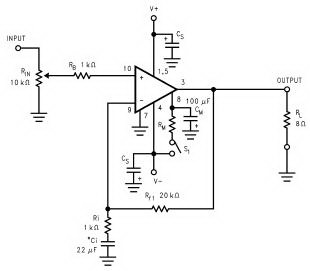
Circuit Project: Small Audio Amplifiers Using LM386 and NE5534

As already said above, the main attraction of the LM386 is the extreme simplicity of its application circuit. You can even eliminate R1 if the signal source is DC-grounded. If the speaker leads are long, you should add an RC snubber across the output to aid stability. Additionally, if you need higher gain (not necessary if the input is at line level), you can connect a 10uF capacitor between pins 1 and 8. Thats about all there is to it.

Now the bad news: This circuit produced a very high level of distortion! The second harmonic measured just -28dB from the main output. The third harmonic was at -35dB, while the noise level was at -82dB. There were assorted high harmonics at roughly -45dB. With music, the distortion was really disturbing, and also the noise level was uncomfortably high. The power supply rejection is poor, so that some hum and other supply noise gets through. In short, this was a lousy performance!

Since I had used so many LM386s in my projects, I had several different variations. In my material box I found a slightly newer LM386N-1. So I plugged it into my test amplifier. It was even worse! The second harmonic was at -24dB, the third harmonic at -31dB, while the noise was a tad better at -84dB. Folks, thats a total harmonic distortion of almost 7%! And the 0.1W output level at which this was measured is where such a circuit is about at its best...  The distortion can be plainly seen on the oscilloscope, and a visibly distorted waveform is about the most offending thing an audio designer can ever see!

Looking through my projects, I found one where I had used a GL386 chip. This is just a 386 made by another company. I unsoldered it and put it in my test amplifier. Surprise! It was dramatically better, with the second harmonic at -45dB, and the third at -57dB! The noise floor was -84dB, just like the LM386N-1. But even this level of distortion was plainly audible when listening to music. Thats roughly 0.6% THD. Some folks may consider it acceptable for music. I dont, but for communication equipment its fine. At this point, I decided to see if I could build a better amplifier, that doesnt become too complex nor expensive.

Circuit Project: Small Audio Amplifiers Using LM386 and NE5534

This was the first attempt. A low distortion, fast slew rate, but easy to find and rather inexpensive operational amplifier, driving a simple source follower made of two small transistors. These transistors are not biased, so they work at zero quiescent current, in full class B. The only mechanism that works against crossover distortion here is the high slew rate of the OpAmp, which is able to make the distortion bursts during crossover very short. To say the truth, I didnt expect to get usable performance from this circuit, and was really surprised when it worked much better than the 386! The second harmonic was at -77dB, the third at -79dB!

Also there were many high harmonics at roughly -84dB. That means a THD of about 0.015%.  The noise floor was down at the -120dB level! The power supply rejection was excellent, with no detectable feedtrough. Playing music, this amplifier sounded really good: No audible noise, and the distortion could be heard when paying attention to it, but I doubt that the average person would detect it! Not bad, for a bias-less design!

Just to see how important the slew rate of the OpAmp is, I pulled out the NE5534 and replaced it by a humble 741, which is many times slower. The result was dramatic: The second harmonic still good at -70dB, but the third harmonic was much worse, at -48dB. Also there were many high harmonics at the same -48dB level. Given that second harmonic distortion doesnt sound bad to most people, but third harmonic does, and high harmonics are even worse, it came as no surprise that the amplifier with the 741 sounded bad.

At low volume it sounded particularly bad! So I returned to the oscillator and measurement setup, testing at lower output power, and found that while the second and third harmonics followed the output, the high harmonics stayed mostly constant! So, at very low output, the high harmonics became very strong relative to the output. All this is the effect of the slower slew rate of the 741, which makes it less effective correcting the crossover distortion of the unbiased transistors. Interestingly, the noise floor of the 741 circuit wasnt bad: -118dB.

Just for fun, I tried this circuit with a third OpAmp: The TL071, which is good, but not as good as the 5534. The results: Second harmonic at -72dB, third and the high ones at -60dB, and the noise at -120dB. Its interesting that the second harmonic is much more suppressed than the third one. That must be a balancing effect of the symmetric output stage, and the better symmetry in the TL071 compared to other OpAmps.

Its worthwhile to note that this amplifier can be simplified a lot by using a split power supply. R1, R2, C1, C2 and C4 would be eliminated! But then you need the capacitor removed from C4 to bypass the negative supply line. The positive input of the chip goes to ground, while pin 4 and the collector of Q2 go to the negative supply. The rest stays the same. If you use a +-15V supply, the available RMS output power grows to over 10 Watt! Of course, you then need larger transistors. And since larger transistors are slower, the distortion will rise somewhat. An added benefit of a split supply is that the popping noise when switching on and off is eliminated.

Circuit Project: Small Audio Amplifiers Using LM386 and NE5534

As the next experiment, I decided to get rid of the crossover distortion. For this purpose, I added a traditional adjustable bias circuit with a transistor and a trimpot. Now I also had to add a current source, because with the bias circuit there is no single point into which the OpAmp could put its drive current into both bases! I adjusted the bias for the best distortion, and this was really  a good one! The second harmonic was down right where the test oscillator delivered it, about -80dB, so I couldnt really measure it!

The third harmonic was at -84dB, and the best improvement was that the higher harmonics had simply disappeared! They were all below the noise floor, which stayed at -120dB. Actually, this noise floor seems to come from the soundcard A/D converter, so that the actual noise of this and the above amplifier may even be better! With music, this amplifier sounded perfect - clean and smooth. And Im pretty confident that the THD is well below the limits of my measurement setup, which is 0.01%.

The quiescent current was around 10mA. When lowering it to about 3mA, the high harmonics started to rise out of the noise floor. If you want to adjust the bias for the exact best quiescent current, there is a simple trick: Lift R4 from the output, and connect it to pin 6. Now the output stage has been left outside the feedback loop, and all its distortion will show up at the output. Watching the signal on an oscilloscope, or even better on a real time spectrum analyzer (soundcard and software), adjust the trimpot to the lowest distortion level.

Have a current meter in the supply line and make sure that you dont exceed 30mA or so of quiescent current, in order to keep the small transistors cool. But most likely the best distortion will be at a current lower than that. Once the adjustment is complete, return R4 to its normal position. Now the full gain and slew rate of the operational amplifier is used to correct the small remaining cross-over distortion of the output stage, and the distortion will certainly disappear from the scope screen, from your ears, and possibly fall below the detection level of the spectrum analyzer!

This circuit can also be run from a split power supply, by exactly the same mods as for the previous circuit. And since the transistors are properly biased, there isnt any significant distortion increase when using larger transistors. Be sure to use some that have enough gain - you have only a few mA of driving available, and with a +-15V power supply and an 8 Ohm speaker, there can be almost 2A of output current! So, you need a gain of 300 at least. There are power transistors in the 4A class that provide such gain, and these are good candidates. The other option is using Darlington transistors, which far exceed the gain needed here. But they will again increase the distortion, not very much, but perhaps enough to make it audible again.
 
 
Source: Humo Luden
Read more

Friday, September 19, 2014

Audio Controlled Mains Switch Circuit Diagram

This is a simple Audio Controlled Mains Switch Circuit Diagram. Simple but very forkful project for audio liker circuit. This circuit will switch off the line supply to audio or video equipment if there has been no input signal for about 2 seconds. SI provides manual operation and S2 acts as a reset. This circuit allows for time to change a tape or compact disc.About 50 mV of audio signal is necessary. Read:  Solid-State Switch For Dc-Operated Gadgets


Audio Controlled Mains Switch Circuit Diagram


Build a Audio Controlled Mains Switch Circuit Diagram


Sourced By : Circuitsstream
Read more

Simple Low Distortion Audio Amplifier Circuit Diagram

This is the Simple Low Distortion Audio Amplifier Circuit Diagram. The circuit was designed and sold as a card by a purveyor of surplus components but, even using mostly manufacturers rejected transistors, we managed to get about 0.02% total harmonic distortion at 30 watts with a ±25v power supply into 8 ohms.: no bad figure even in these days of MOSFET and ICs. In 1977 anything below 0.1% was considered excellent. And this figure was pretty repeatable without doing much selection. 

The problem of course is that since I havent touched this amplifier for many a year I have absolutely no idea what modern transistor types one should use for it but they are not critical: output transistors and drivers need to be the correct type but the other transistors can be small signal types - as long as they can handle the full voltage between + and - supplies. 

Simple Low Distortion Audio Amplifier Circuit Diagram


Simple Low Distortion Audio Amplifier Circuit Diagram


Tr1 and Tr2 are a long-tailed pair (LTP to save typing). It is quite common to have a LTP in an audio amp but this is different: this is a complimentary LTP. As far as I am aware no one else had used a complimentary LTP at the time, though I have since seen it used in one other circuit. So I guess the circuit is unique to the author. One of the things that limits the performance of a conventional LTP is that the tail source loads the common emitters. In a complementary LTP this cant happen as there is no tail current source so that all the current of one transistor has to flow through the other.

Tr2s collector current flows into D1 and D2 which develop a voltage: this is used to bias Tr8 as a constant current source for Tr4s collector. The fact that Tr4 is working at a constant current defines its base-emitter voltage which must be developed across R4. This defines a current in R4 and this is the current that the LTP must operate at - so the ring of four transistors (Tr1, 2, 3, & 4) is self biasing and all transistors work at their best with minimum unwanted loads and biasing detracting from the performance. Tr4 is actually one of the most critical transistors: in the original circuit it was selected for Vce greater than 75v. Most Texas BC212s passed easily. Lower voltage transistors caused an increase in distortion level.

There is always a down side to any circuit: in the conventional LTP the base-emitter voltages tend to cancel each other out. In the complimentary LTP they add so there is a drop of about 1.2v between the two bases: this must be cancelled in the biasing chain and, since this circuit was designed for operation over a wide range of supply voltage, I had to be a little clever. Because of the constant current operation of the LTP and the constant voltage drop across D1 & D2, there is also a constant voltage across R14. This drop is used to lift up the bottom of the biasing chain (R1 and R11) so that the output sits at around half supply voltage, over a wider supply range.

D3 and D4 develop a bias voltage so that the output transistors are at the correct point, slightly conducting, to minimise crossover distortion.

The output transistors are complimentary (the original design used MJE2011 and MJE2021) and are driven by complimentary drivers: PNP driving NPN and vice versa. This arrangement is not only pleasingly symmetrical but gives better performance that the more common Darlington arrangement - the full gain of all the transistors is used and there is more internal feedback and less voltage drop.

The output current is monitored in the two resistors R7 and R22 (180 milliohms). The current limiting is unusual in that it works inside the input ring at an earlier stage than normal. This has an advantage that the current limiting transistors do not load the drive circuitry - which will introduce distortion. The slight down side is that there may be a slight tendency to oscillation when in current limit. R3 and R14 are necessary to restrict the current availability when the current limit engages. R5 and R19 are present to make the current limit vary with the voltage across the power transistors to avoid the second breakdown region of power transistors.

The points shown connecting terminals 1-2 and 6-7 are scratch-through tracks. 1 and 2 are the power and signal earths: to keep distortion in a stereo system to a minimum the currents in these must never share the same path so in a stereo system four earth wires are run to the systems common earth point - a spider common earth - and this means breaking the link. The link between 6 & 7 is in the feedback path and there are times when this can usefully be broken - one cheapskate was to fit a tone control circuit here (see below). It works fine but is a bit of an insult to such a low-distortion design!. A third break point is in the collector of Tr2. Breaking this shuts down the amplifier completely and safely. Is a thermal switch is to be fitted, this is the place.

Overall negative feedback is in two parts: D.c. is fed back via R13: there is 100% d.c. feedback. A.c. feedback is via R12 and R17. Note the output capacitor is inside this feedback loop (speaker connects between terminal 5 and negative) which extends the low frequency response.

Another feature is the accessibility of both ends of the output coupling capacitor: being designed for a junk shop, they didnt want to use expensive capacitors! So for extra bass performance an additional capacitor can easily be connected.

The circuit can also be driven as a low input impedance: break 6-7, short pin 8 to C4s positive and apply input to pin 6. In this mode the input distortion is actually better: my original notes show as low as 0.01%!

When building a low-distortion amplifier, layout is vital. In fact to get distortion around 0.02% requires a lot of skill and experience. The problem is that the current in the output stage alternates between the two power transistors so is a rectified version of the input. Now there is no such thing as a wire. Any real piece of wire or copper track is a resistor with associated inductance and capacitance. If the high current, rectified output signal mixes in the same piece of wire with the input signal the distortion in the rectified output current will feed into the input and cause the overall distortion to rocket. This is something which cannot properly be taught but has to be experienced. A skilled audio engineer will spend his lifetime learning about it.

Another interesting idea which is not shown is to fit a resistor between pin 3 and R18. This decreases the current at higher voltages and allows it to increase at low supply voltages. My notes show that this had a considerable advantage for low voltage operation because it increases the bias. It also is positive feedback which increase the open-loop voltage gain. It never got incorporated and I dont remember the details.

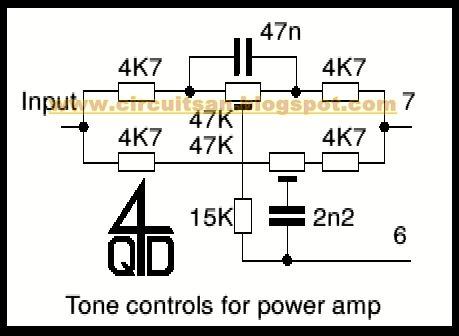
Tone controls

Tone controls

The circuit shows a simple (but effective) way of adding tone controls around the power amp. This does increase the distortion a little so it is not as hi-fi a solution as a separate tone control stage, but it is simple and quite effective.

To use the tone controls you must break the link between 6 and 7 on the circuit. Also the 150K resistor, R13, should be decoupled. Replace it by two 68K resistors in series. The centre point of these two connects to the positive of a 1µ electrolytic whose negative connects to the earth (0v) line. This stops R13 acting as negative feedback which otherwise would shunt the tone controls.


Sourced by : Author: Richard Torrens
Site hosted by Arachsys
Read more

6 18 Volt audio power amplifier

audio
This time I will post about the audio amplifier based on IC KA2204. In an audio amplifier circuit has a power output that can also be referred to as a low-grade resources that have only 6 Watts output with 4 Ohm impedance. Frequency response 30 Hz to 18 kHz . For the scheme can be seen below.


Supply
Supply voltage and a maximum of at least 6 Volt to 18 Volt

Part List
R1 =  56R
C1 = 1uF
C2 = 220uF
C3 = 100uF
C4 = 47uF
C5 = 1000uF
C6 = 100nF
C7 = 470pF
C8 = 22pF
C9 = 47uF
C10 = 47pF


Read more

TV audio video transmitter Schematic Diagram

This is a simple TV audio video transmitter circuit can be constructed using this schematic diagram . This TV audio video transmitter circuit can be used to transmit video signals from VCR ( or some other device ) to a TV without using any cable .

Video signals input at jack J1 are first terminated by resistor R6 and coupled through capacitor C1 to clamping-diode D1. Potentiometer R3 is used to set the gain of the video signal; its effect is similar to that of the contrast control on a TV set.

TV audio video transmitter Schematic Diagram

TV audio video transmitter Schematic Diagram

Bias-control R7 can be used to adjust the black level of the picture so that some level of signal is transmitted, even for a totally dark picture.

RF-transformer T1 and its internal capacitor form the tank circuit of a Hartley oscillator thats tuned to 4.5 megahertz. Audio signals input at J2 are coupled to the base of Q3 via C2 and R4: the audio signal modulates the base signal of Q3 to form an audio subcarrier that‚s 4.5-megahertz higher than the video-carrier frequency.

The FM modulated subcarrier is applied to the modulator section through C5 and R9.
Resistor R9 adjusts the level of the subcarrier with respect to the video signal.

Transistors Q1 and Q2 amplitude modulate the video and audio signals onto an RF-carrier signal. The operating frequency is set by coil L4, which is 3.5 turns of 24- gauge enameled wire on a form containing a standard ferrite slug.

The RF output from the oscillator (L4, C7 and C9 ) section is amplified by Q5 and Q6, whose supply voltage comes from the modulator . Antenna matching and low-pass filtering is performed by C12, C13, and L1.

Resistor R12 is optional; it is added to help match the output signal to any kind of antenna.
To align this audio video transmitter you need to tune a TV receiver to an unused channel between 2 and 6. The TV must have an indoor antenna connected directly to it; an outdoor antenna or cable wont work. Make sure both potentiometers (R3, R7) are in middle position and apply power to the transmitter. Adjust L4 with a nonmetallic tool until the TV screen goes blank ,then fine-adjust L4 for the "most-blank" picture.
Connect the video and audio outputs from a VCR(AV source) to jacks J1 and J2 (respectively) of the transmitter .

After that you should see a picture on the TV screen: if you do, readjust L4 for the best picture; if you dont, check the board for any bad connections. Next, adjust R3 for the best picture brightness and R7 for the best overall picture.

Finally, adjust T1 with a nonmetallic tool for the best sound .
The TV transmitter combines line level audio and video signals, and transmits the resulting signal up to 300 feet. The circuit can be powered from a 9-12V power supply circuit .

Read more

3khz Low Pass Filter and Audio Amplifier Circuit Diagram

This circuit uses a switched capacitor filter IC from National Semiconductor to filter signals with frequencies higher than the 3KHz needed for voice audio. The schematic includes an audio amplifier that is designed to drive a standard audio head phone. 

The circuit is described in more detail in the receiver section of Dave Johnsons Handbook of Optical Through the Air Communications.(this link is off-site)


 3khz Low Pass Filter and Audio Amplifier Circuit Diagram

 3khz Low Pass Filter and Audio Amplifier Circuit Diagram
 
Read more