Showing posts with label amplifier. Show all posts

Wednesday, November 19, 2014

Audio Power Amplifier LM3886

Audio Power Amplifier is an important part in the reproduction of sound in a sound system. Audio Power Amplifier LM 3886 with power IC Audio Power Amplifier is a highly capable and able to produce 68 Watts with power rata2 4Ohm load and capable of producing power 38 Watt with 8Ohm load. With good sound reproduction capabilities of 20Hz-20kHz is also included on this LM3886 Audio Power Amplifier. LM3886 Audio Power Amplifier is equipped with spike protection that will protect the output circuit from overvoltage, undervoltage, overloads, konrsleting power supply, thermal runawaydan peak temperature. Audio Power Amplifier LM3886 also features a noise reduction system which can keep the audio from the noise well.

Image of Basic Audio Power Amplifier Series LM3886
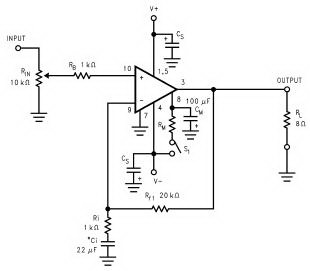
Audio


Audio Power Amplifier LM3886

Feature owned LM3886 Audio Power Amplifier

  • 68W cont. avg. output power into 4Ω at VCC = ± 28V
  • 38W cont. avg. output power into 8Ω at VCC = ± 28V
  • 50W cont. avg. output power into 8Ω at VCC = ± 35V
  • 135W instantaneous peak output power capability
  • Signal-to-Noise Ratio ≥ 92dB
  • An input mute function
  • Output protection from a short to ground or to the supplies via internal current limiting circuitry
  • Output over-voltage protection against transients from inductive loads
  • Supply under-voltage protection, not allowing internal biasing to occur Pls | VEE | + | VCC | ≤ 12V, Thus eliminating turn-on and turn-off transients
  • 11-lead TO-220 package
  • Wide supply range 20V - 94V
  • Application of Audio Power Amplifier LM3886
  • Stereo audio system
  • Active Speaker
  • High End Audio Power TV
  • Suround Power Amplifier
Read more

Tuesday, November 18, 2014

1000 Watt Power Amplifier

Power amplifier has up to 1000 Watt power, this circuit made one channel only so if you want to create a stereo in it must be made one again, actually this is more suitable power amplifier in use for Sound System or outdoor, so if only in use for the house I think is less suitable.
Maybe youve seen or even have an active speaker and there is written 1500 watts PMPO (Peak Music Power Output), make no mistake this is different from Power Amplifier Active Speaker, I often dismantle such Active Speaker in it only a power with power no more than 150 watts by using the transformer 2-3 Ampere. PMPO is not a real power which is issued by the Power Amplifier, but counting all the speakers that there is, for example: if there are 5 pieces of speakers on each channel and each speaker has a power of 10 W then it is 100 W PMPO.
1000W Power Amplifier schematics
Part List 1000W amplifier
While this 1000 Watt Power Amplifier minimal use transformer 20 Ampere. And the output of Power Amplifier DC voltage contains approximately 63 volts, with currents and voltages of this magnitude, this 1000 Watt Power Amplifier will not hesitate hesitate to destroy your woofer speakers to connect. To overcome that then before the speaker on connects to 1000 Watt Power Amplifier must be in pairs Speaker Protector.

Actually if you want to create a Power Amplifier with great power does not have to make a Power Amplifier with great power. Example: you want to create a Power Amplifier with 10 000 Watt power. You do not have to assemble a Power Amplifier with power of 10,000 watts, but you assemble the power Power Amplifier Small but many, such as you assemble the Power Amplifier with 1000 Watts of power for as many as 10 pieces, it will produce 10 000 Watt Power Amplifier helpless.

Circuit uses power transistors pair of 5 x 5 x 2SA1216 and 2SC2922 and 2SC1583 use a differential amplifier that actually contains 2 pieces of transistors that are in containers together. Why use such built-in amplifier differental tujuanya so identical / similar, could have uses 2 separate transistors but can result in amplifier so it is not symmetrical.

Tips combining speaker.

To get the speakers with great power combining techniques can be used in parallel series, combining each group of speakers should sepaker they will have the same impedance, the same type (Woofer, Mid Range or tweeter) and the same power. Number of merging these speakers should consists of 4 , 9, 16 ff, see picture
Speaker wiring


Example: The number of speakers have 4 pieces each of its 200 Watt power generated will be a speaker at = 200 x 4 = 800 Watt. If there are 9 speakers 200 W then the result = 9 x 200 W = 1800 Watt.
Read more

Subwoofer power amplifier IC OPA541BM

Subwoofer power amplifier circuit based on IC OPA541BM very suitable for use in subwoofer speakers, these amplifiers possess excellence in sound issud because the sound is very clear and issued in accordance with subwoofer speakers in a low tone.
Subwoofer power amplifier IC OPA541BM Circuit

Read more

Monday, November 17, 2014

LM4651 and LM4652 170W power amplifier

170 Watt power amplifier is a power amplifier that is built by IC LM4651 and LM4652. Part of this power amplifier driver using the LM4651 IC designed specifically for the purpose of the class AB amplifier driver with short circuit protection feature, containing under voltage, thermal shutdown protection and standby functions. Section 170 Watt power amplifier using LM4651 IC with a MOSFET power amplifier is equipped with temperature sensors that will be used by IC LM4651 as controlnya thermal signal. IC IC LM4651 and LM4652 are designed specifically to each other in pairs to create a class AB power amplifier with protection features are detailed. Detailed series of 170 Watt power amplifier can be seen in thethe following figure .

LM4651

Power amplifier circuit requires supply voltages +22 V DC symmetrical 0-22V. Power Amplifier with IC LM4651 and LM4652 are often used in portable HiFi systems such as powered speakers, power subwoofer and car audio power Booter. D1, D2, D3 and D4 in series 170 watt power amplifier with LM4651 and LM4652 is a 22V zener diode.
Read more

Tuesday, November 11, 2014

Thursday, November 6, 2014

Precision Headphone Amplifier

Designs for good-quality headphone amplifiers abound, but this one has a few special features that make it stand out from the crowd. We start with a reasonably conventional input stage in the form of a differential amplifier constructed from dual FET T2/T3. A particular point here is that in the drain of T3, where the amplified signal appears, we do not have a conventional current source or a simple resistor. T1 does indeed form a current source, but the signal is coupled out to the base of T5 not from the drain of T3 but from the source of T1. Notwithstanding the action of the current source this is a low impedance point for AC signals in the differential amplifier.  

Precision Headphone Amplifier Circuit Diagram


Measurements show that this trick by itself results in a reduction in harmonic distortion to considerably less than –80 dB (much less than 0.01 %) at 1 kHz. T5 is connected as an emitter follower and provides a low impedance drive to the gate of T6: the gate capacitance of HEXFETs is far from negligible. IC1, a volt-age regulator configured as a current sink, is in the load of T6. The quiescent current of 62 mA (determined by R11) is suitable for  an output power of 60 mWeff into an impedance of 32 Ω, a value typical of high-quality headphones, which provides plenty of volume.


Using higher-impedance headphones, say of 300 Ω, considerably more than 100 mW can be achieved. The gain is set to a useful 21 dB (a factor of 11) by the negative feedback circuit involving R10 and R8. It is not straightforward to change the gain because of the single-sided supply: this voltage divider also affects the operating point of the amplifier. The advantage is that excellent audio quality can be achieved even using a simple unregulated mains supply.  Given the relatively low power output the power supply is considerably overspecified. Noise and hum thus remain more than 90 dB below the signal (less than 0.003 %), and the supply can also power two amplifiers for stereo operation.

The bandwidth achievable with this design is from 5 Hz to 300 kHz into 300 Ω, with an output voltage of 10 Vpp. The damping factor is greater than 800 between 100 Hz and 10 kHz. A couple of further things to note: some-what better DC stability can be achieved by replacing D1 and D2 by low-current red LEDs (connected with the right polarity!). R12 prevents a click from the discharge of C6 when headphones are plugged in after power is applied. T6 and IC1 dissipate about 1.2 W of power each as heat, and so cooling is needed. For low impedance headphones the current through IC1 should be increased. To deliver 100 mW into 8 Ω, around 160 mA is required, and R11 will need to be 7.8 Ω (use two 15 Ω resistors in parallel).

To keep heat dissipation to a reasonable level, it is recommended to reduce the power supply volt-age to around 18 V (using a transformer with two 6 V secondaries). This also means an adjustment to the operating point of the amplifier: we will need about 9V between the positive end of C6 and ground. R4 should be changed to 100 Ω, and R8 to 680 Ω. The gain will now be approximately 6 (15 dB). The final dot on the ‘i’ is to increase C7 by connecting another 4700 µF electrolytic in parallel with it, since an 8 Ω load will draw higher currents.
Read more

Monday, November 3, 2014

Friday, October 31, 2014

Headphone Amplifier Using Discrete Components

An amplifier to drive low to medium impedance headphones built using discrete components.

Both halves of the circuit are identical. Both inputs have a dc path to ground via the input 47k control which should be a dual log type potentiometer. The balance control is a single 47k linear potentiometer, which at center adjustment prevents even attenuation to both left and right input signals. If the balance control is moved towards the left side, the left input track has less resistance than the right track and the left channel is reduced more than the right side and vice versa. The preceding 10k resitors ensure that neither input can be "shorted" to earth.

Circuit diagram:Headphone
Headphone Amplifier Circuit Diagram

Amplification of the audio signal is provided by a single stage common emitter amplifier and then via a direct coupled emitter follower. Overall gain is less than 10 but the final emitter follower stage will directly drive 8 ohm headphones. Higher impedance headphones will work equally well. Note the final 2k2 resistor at each output. This removes the dc potential from the 2200u coupling capacitors and prevents any "thump" being heard when headphones are plugged in. The circuit is self biasing and designed to work with any power supply from 6 to 20 Volts DC
Read more

Tuesday, October 28, 2014

Alpine Audio Amplifier 500 Watt RMS

Alpine
Alpine
Alpines Amplifier to chain is a good series of normal-grade amplifiers. They arent lofty terminate, but they value is isnt "high end" either. They are efficient and control well with vehicles with the purpose of dont exactly say a bundle of further amps free in support of powering amplifiers. I run an MRP-M500 and an MRP-F300 arrived my Honda Fit and they both supply me with capable, clean power not including taxing my cars electrical usage.

In my system, the M500 is powering a 12" subwoofer in a insignificant, sealed box. with the purpose ofs not exactly a formula meant for greatest extent deep shock, but the M500 does a major occupation pushing my subwoofer to its fullest budding. The classify-D circuitry makes the amp very efficient so with the purpose of it bidding effort well clothed in nearly all vehicles electrical systems.

The lone downside Ive found is to the EQ functions are relatively inadequate. You comprehend controls designed for hub frequency, crossover advantage, and low boost. It makes it a minute other intricate to get a smooth sound flanked by this amp and your four-channel amp. It presently takes longer than if in attendance were supplementary EQ controls. too, the low boost puts a definite crest voguish its frequency output so so as to the amplitude drops sour higher than and underneath the inside frequency. That earnings that if you like to step the greatest power output, your range is open to come to pass somewhat inadequate.

Overall, Im very glad with the M500. seeing that extended as youon the subject of not looking to power a massive, inefficient subwoofer, it be supposed to donate you a very smooth, musical sound.

MRP-M500 - Alpine Monoblock 500 Watt RMS Power Amplifier  :

Product Features

  • Mono subwoofer car amplifier
  • 300 watts RMS x 1 at 4 ohms (500 watts RMS x 1 at 2 ohms)
  • Class D amp with MOSFET power supply
  • 10-11/16"W x 2-7/16"H x 9-9/16"D

Technical Details

  • Brand Name: Alpine
  • Model: MRP-M500
  • Faceplate Type: Detachable
  • Device Type: Amplifier
  • MP3 player: N
  • Warranty: 1 year warranty

Read more

Sunday, October 26, 2014

3 Watt stereo amplifier circuit

3 Watt stereo amplifier circuitusing MAX 7910 IC. The MAX9710 a stereo audio power amplifier IC capable of delivering 3Watts of out put to 4 Ohm loads. MAX9710 can be operated from a single 4.5V to 5.5V power supply , makes it ideal for hand held applications.The IC for 3 Watt stereo amplifier circuit also features thermal overload protection.


Circuit Schematics 3 Watt  Stereo Amplifier MAX 7910 
3 Watt stereo amplifier circuit 

This  3 Watt stereo amplifier circuit  is suitable for small power audio devices such as radio sets and portable CD players. 5 V DC power supply is used for powering the  3 Watt stereo amplifier circuit. 6V battery with an IN 4007 diode series to the positive terminal of it can also be used instead of 5 V DC supply. The  3 Watt stereo amplifier circuit will get a supply voltage approximately 5 V after 0.7 V voltage drop across diode.

Read more

Saturday, October 25, 2014

Output Relay Delay Audio Amplifier Diagram Circuit

This is a simple circuit which I built to one of my audio amplifier projects to control the speaker output relay. The purpose of this circuit is to control the relay which turns on the speaker output relay in the audio amplifier. The idea of the circuit is wait around 5 seconds ofter the power up until the speakers are switched to the amplifier output to avoid annoying "thump" sound from the speakers. Another feature of this circuit is that is disconnects the speaker immediately when the power in the amplifier is cut off, so avoiding sometimes nasty sounds when you turn the equipments off.

Circuit diagram:
Audio Amplifier Output Relay Delay Circuit Diagram
Component list
C1 = 100 uF 40V electrolytic
C2 = 100 uF 40V electrolytic
D1 = 1N4007
D2 = 1N4148
Q1 = BC547
R1 = 33 kohm 0.25W
R2 = 2.2 kohm 0.25W
RELAY 24V DC relay, coil resistance >300 ohm

Circuit operation:

Then power is applied to the power input of the circuit, the positive phase of AC voltage charges C1. Then C2 starts to charge slowly through R1. When the voltage in C2 rises, the emitter output voltage of Q1 rises together with voltage on C2. When the output voltage of Q2 is high enough (typically around 16..20V) the relay goes to on state and the relay witches connect the speakers to the amplifier output. It takes typically around 5 seconds after power up until the relay starts to conduct (at absolute time depends on the size of C2, relay voltage and circuit input voltage). When the power is switched off, C1 will loose its energy quite quickly. Also C2 will be charged quite quickly through R2. In less than 0.5 seconds the speakers are disconnected from the amplifier output.

Notes on the circuit:
This circuit is not the most accurate and elegant design, but it has worked nicely in my small home-built PA amplifier. This circuit can be also used in many other applications where a turn on delay of few seconds is needed. The delay time can be increased by using bigger C2 and decreased by using a smaller C2 value. Note that the delay is not very accurate because of simplicity of this circuit and large tolerance of typical electrolytic capacitors (can be -20%..+50% in some capacitors).
Author: Tomi Engdahl
Read more

Thursday, October 23, 2014

50W Circuits Car Subwoofer Amplifier

The Car Subwoofer Amplifier 50W Circuit was posted by the side of trendy kind Amplifier. Please examine carefully and look on circuit design pictures of Car Subwoofer Amplifier 50W Circuit to catch aspect in sequence.
50W Circuits Car Subwoofer Amplifier 

This car stereo amplifier with TDA1562Q so as to can output 50W of audio power. at this time’s the complete incline :
2 resistors 1 KOhms
2 resistors 4,7 KOhms
2 resistors 100 KOhms
2 resistors 1 MOhms
4 capacitors 470 nF LCC 63V
4 capacitors 10 µF 63V radiaux
6 capacitors 4 700 µF 25V radiaux
2 capacitors 100 nF LCC
1 capacitor 10.000µF 25V radial
2 x LED
2 x TDA1562Q
2 switches unipolaires
2 heatsink (Rth <2.5°c/w) (+ pasta termica)
Read more

Saturday, October 18, 2014

9v Portable Headphone Amplifier circuit and explanation

High Quality One-IC unit, Low current consumption-After several requests by correspondents, the decision of designing a 9V powered Headphone Amplifier was finally taken. The main requirement was to power the circuit by means of a common, PP3 (transistor radio) alkaline battery. So, implementing a low current drawing circuit was absolutely necessary, though preserving a High Quality performance.

Circuit Diagram:

Large View


Parts:

P1 = 22K
R1 = 18K
R2 = 68K
R3 = 68K
R4 = 68K
R5 = 18K
R6 = 68K
C1 = 4.7uF-25v
C2 = 4.7uF-25v
C3 = 22pF
C4 = 220uF-25v
C5 = 220uF-25v
C6 = 4.7uF-25v
C7 = 22pF
C8 = 220uF-25v
J1 = 3.5mm Stereo Jack
B1 = 9V Alkaline Battery
IC1 = NE5532-34
SW1 = SPST Toggle Switch


More:
  • The appearance of the 5534 low-noise op-amp at a reasonable price was much appreciated by audio designers. It is now difficult or impossible to design a discrete stage that has the performance of the 5534 without quite unacceptable complexity.
  • 5534 op-amps are now available from several sources, in a conventional 8-pin d.i.l. format. This version is internally compensated for gains of three or more, but requires a small external capacitor (5-15pF) for unity-gain stability. The 5532 is a very convenient package of two 5534s in one 8-pin devices with internal unity-gain compensation, as there are no spare pins.
  • The 5534/2 is a low-distortion, low-noise device, having also the ability to drive low-impedance loads to a full voltage swing while maintaining low distortion. Furthermore, it is fully output short-circuit proof. Therefore, this circuit was implemented with a single 5532 chip forming a pair of stereo, inverting amplifiers, having an ac gain of about 3.5 and capable of delivering up to 3.6V peak-to-peak into a 32 Ohm load (corresponding to 50mW RMS) at less than 0.025% total harmonic distortion (1kHz & 10kHz).


Source : www.redcircuits.com
Read more

Thursday, October 9, 2014

LA47536 bassed high power car audio amplifier circuit with explanation


This car audio amplifier circuit is based on LA47536 audio amplifier integrated circuit designed by Sanyo . This audio amplifier circuit is specially designed for car audio power amplifiers and . LA47536 car audio amplifier IC has four output channels and is capable to provide a maximum output power of 45 watts on each channel on a 4 ohms load with 10% THD .
The LA47536 includes almost all the functions required for car audio use, including a standby switch, muting function, and various protections (output pin-to-VCC short , output pin-to-GND short ,load short , over voltage , thermal shut down circuit ). It also provides a self-diagnosis function (output offset detection).

Also this audio amplifier IC has a voltage gain of 32 dB and a self-diagnosis function that detects the output offset . For powering this car audio amplifier circuit you will need a 14. 4 volts DC , or you can use the car battery ( if you will use it for car ) .
Using a 12 volts Dc power supply , the output power will be a little low , but the distortion ( THD ) will be very low .

Read more

Wednesday, September 24, 2014

Battery powered Headphone Amplifier

Low distortion Class-B circuitry 6V Battery Supply
Some lovers of High Fidelity headphone listening prefer the use of battery powered headphone amplifiers, not only for portable units but also for home "table" applications. This design is intended to fulfil their needs and its topology is derived from the Portable Headphone Amplifier featuring an NPN/PNP compound pair emitter follower output stage. 

An improved output driving capability is gained by making this a push-pull Class-B arrangement. Output power can reach 100mW RMS into a 16 Ohm load at 6V supply with low standing and mean current consumption, allowing long battery duration. The single voltage gain stage allows the easy implementation of a shunt-feedback circuitry giving excellent frequency stability.
.
Circuit diagram :
Battery-powered Headphone Amplifier Circuit diagram
Notes:
  • For a Stereo version of this circuit, all parts must be doubled except P1, SW1, J2 and B1.
  • Before setting quiescent current rotate the volume control P1 to the minimum, Trimmer R6 to maximum resistance and Trimmer R3 to about the middle of its travel.
  • Connect a suitable headphone set or, better, a 33 Ohm 1/2W resistor to the amplifier output.
  • Switch on the supply and measure the battery voltage with a Multimeter set to about 10Vdc fsd.
  • Connect the Multimeter across the positive end of C4 and the negative ground.
  • Rotate R3 in order to read on the Multimeter display exactly half of the battery voltage previously measured.
  • Switch off the supply, disconnect the Multimeter and reconnect it, set to measure about 10mA fsd, in series to the positive supply of the amplifier.
  • Switch on the supply and rotate R6 slowly until a reading of about 3mA is displayed.
  • Check again the voltage at the positive end of C4 and readjust R3 if necessary.
  • Wait about 15 minutes, watch if the current is varying and readjust if necessary.
  • Those lucky enough to reach an oscilloscope and a 1KHz sine wave generator, can drive the amplifier to the maximum output power and adjust R3 in order to obtain a symmetrical clipping of the sine wave displayed.
Technical data:
Output power (1KHz sinewave):
    16 Ohm: 100mW RMS
    32 Ohm: 60mW RMS
    64 Ohm: 35mW RMS
    100 Ohm: 22.5mW RMS
    300 Ohm: 8.5mW RMS
Sensitivity:
    160mV input for 1V RMS output into 32 Ohm load (31mW)
    200mV input for 1.27V RMS output into 32 Ohm load (50mW)
Frequency response @ 1V RMS:
    flat from 45Hz to 20KHz, -1dB @ 35Hz, -2dB @ 24Hz
Total harmonic distortion into 16 Ohm load @ 1KHz:
    1V RMS (62mW) 0.015% 1.27V RMS (onset of clipping, 100mW) 0.04%
Total harmonic distortion into 16 Ohm load @ 10KHz:
    1V RMS (62mW) 0.05% 1.27V RMS (onset of clipping, 100mW) 0.1%
Unconditionally stable on capacitive loads


Source : red circuits

Read more

Low Impedance Microphone Amplifier

The circuit is a microphone amplifier for use with low impedance (~200 ohm) microphones. It will work with stabilized voltages between 6-30VDC. If you dont build the impedance adapter part with T1, you get a micamp for higher impedance microphones. In this case, you should directly connect the signal to C7.


  • R1=15k
  • R2= 150k
  • R3= 2k2
  • R4= 820
  • R6= 10k
  • R7= 10k
  • P1= 1M
  • C1= 3k9
  • C2= 100u
  • C3= 22u
  • C4= 4u7
  • C5= 470u
  • C6= 10u
  • C7= 100n
  • C8= 47u UNIPOLAR
  • D1= 1N4148
  • U1= TL081
  • CN1= SIL6
Read more

Strong Headphone Amplifier

Some lovers of High Fidelity headphone listening prefer the use of battery powered headphone amplifiers, not only for portable units but also for home "table" applications. This design is intended to fulfill their needs. An improved output driving capability is gained by making this a push-pull Class-B arrangement. Output power can reach 100mW RMS into a 16 Ohm load at 6V supply with low standing and mean current consumption, allowing long battery duration.

 Circuit diagram:


High Quality Headphone Amplifier Circuit Diagram

 Parts:

Resistors:
P1 = 22K Potentiometer
R1 = 15K Resistor
R2 = 100K Resistor
R3 = 100K Resistor
R4 = 47K Resistor
R5 = 470R Resistor
R6 = 500R Resistor
R7 = 1K Resistor
R8 = 18K Resistor
R9 = 18K Resistor
R10 = 2.2R Resistor
R11 = 2.2R Resistor
R12 = 33R Resistor
R13 = 4.7K Resistor

Capacitors:
C1 = 10uF-25V Capacitors
C2 = 10uF-25V Capacitors
C3 = 100nF-63V (PF)
C4 = 220uF-25V Capacitors
C5 = 100nF-63V (PF)
C6 = 220uF-25V Capacitors

Semiconductors:
Q1 = BC560C PNP Transistor
Q2 = BC560C PNP Transistor
Q3 = BC550C NPN Transistor
Q4 = BC550C NPN Transistor
Q5 = BC560C PNP Transistor
Q6 = BC327 PNP Transistor
Q7 = BC337 NPN Transistor

Miscellaneous:
J1 = RCA Audio Input Socket
J2 = 3mm Stereo Jack Socket
B1 = 6V Battery Rechargeable
SW1=SPST Slide or Toggle Switch

Notes:

  • For a Stereo version of this circuit, all parts must be doubled except P1, SW1, J2 and B1.
  • Before setting quiescent current rotate the volume control P1 to the minimum, Trimmer R6 to maximum resistance and Trimmer R3 to about the middle of its travel.
  • Connect a suitable headphone set or, better, a 33 Ohm 1/2W resistor to the amplifier output.
  • Switch on the supply and measure the battery voltage with a Multimeter set to about 10Vdc fsd.
  • Connect the Multimeter across the positive end of C4 and the negative ground.
  • Rotate R3 in order to read on the Multimeter display exactly half of the battery voltage previously measured.
  • Switch off the supply, disconnect the Multimeter and reconnect it, set to measure about 10mA fsd, in series to the positive supply of the amplifier.
  • Switch on the supply and rotate R6 slowly until a reading of about 3mA is displayed.
  • Check again the voltage at the positive end of C4 and readjust R3 if necessary.
  • Wait about 15 minutes, watch if the current is varying and readjust if necessary.
  • Those lucky enough to reach an oscilloscope and a 1 KHz sine wave generator can drive the amplifier to the maximum output power and adjust R3 in order to obtain a symmetrical clipping of the sine wave displayed.

Technical data:

Output power (1 KHz sine wave):
  • 16 Ohm: 100mW RMS
  • 32 Ohm: 60mW RMS
  • 64 Ohm: 35mW RMS
  • 100 Ohm: 22.5mW RMS
  • 300 Ohm: 8.5mW RMS
Sensitivity:
  • 160mV input for 1V RMS output into 32 Ohm load (31mW)
  • 200mV input for 1.27V RMS output into 32 Ohm load (50mW)
Frequency response @ 1V RMS:
  • Flat from 45Hz to 20 KHz, -1dB @ 35Hz, -2dB @ 24Hz
Total harmonic distortion into 16 Ohm load @ 1 KHz:
  • 1V RMS (62mW) 0.015% 1.27V RMS (onset of clipping, 100mW) 0.04%
Total harmonic distortion into 16 Ohm load @ 10 KHz:
  • 1V RMS (62mW) 0.05% 1.27V RMS (onset of clipping, 100mW) 0.1%
  • Unconditionally stable on capacitive loads
Source: www.redcircuits.com
Read more

Tuesday, September 23, 2014

100 Watt Power Amplifier Circuit With IC TDA7294

Power Amplifier TDA7294 is a power amplifier with IC Power Amplifier is a mono 100W Class AB operation of OCL.

The power supply circuit. Positive, negative, and ground. Usually, we use the power supply circuit to + /-25V to + /-35V at 100W RMS will be used to heat sufficiently.

After many members have already made the TDA7294 as I know, with a sound quality that is the very gods or Hi-End itself.


Several days before the member’s PM to me saying that I had an amplifier using IC TDA7294 to have more of the same. Higher power. And low heat.

Achieved by increasing the voltage raising circuit For the more, it means high power and high heat up. Today I have come across. I use IC TDA7294 circuit at the time.

In-Home Use amplifier circuit is a Class G amplifier with low power consumption, resulting in the loss of a 20V DC power less.

And when you’re driving a high-power random access is party to a rhythm. Principles to do it. I took out a membership you can do is try to build up a bit.

We provides PCB both top and bottom side for you.
 
Sourced By : Circuitsstream
Read more

Friday, September 19, 2014

KT88 Tube Power Amplifier Class A Circuit

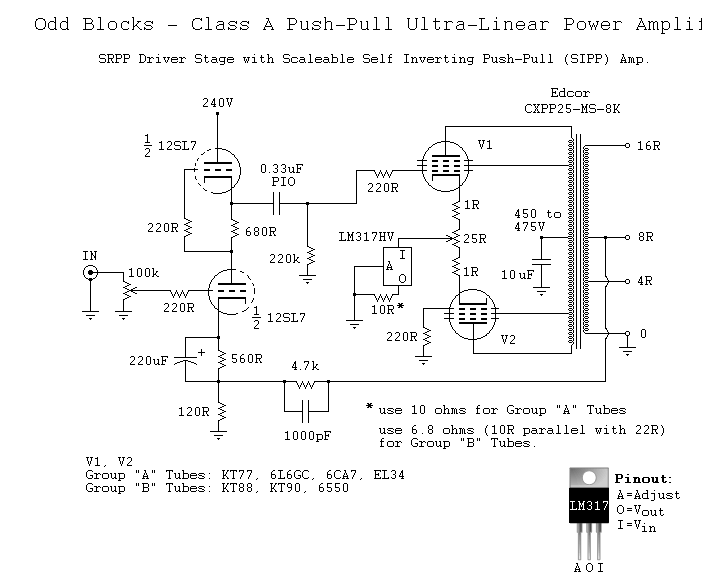
Single Ended Valve Triode Amplifier has not same tone with Push Psu Amplifier. Over 90% of Amplifiers are push pull, and push pull amplifier does not 2nd harmonic and off course does not get 2nd 4th, 6th harmonic vs SE has 2nd, 4th, 6th harmonic. Push pull has minor distortion than SE Amplifier.2nd harmonic is make good tone for Music.not too much and not less than.feel good sound get from Single Ended Amplifiers with high efficiency speakers from 88dB/m to 100dB/m. I means Single Ended Amplifier is almost Single Ended Triode Amplifier.or Penthode but wired Triode. Tone is Different.good for Jazz and small room Classic. 

 KT88 Tube Power Amplifier Class A Circuit


KT88 Tube Power Amplifier Class A Circuit

Read more