Showing posts with label wave. Show all posts

Thursday, November 20, 2014

Sine Wave To TTL Converter

Sine Wave To TTL Converter is a series that we can use to change the sine wave signal with a pulse shape with the same frequency with TTL logic level that we are ready to use in coding the data digitally . The series of Sine Wave To TTL Converter can be used to convert sine wave signal to form a TTL of frequency 100KHz to 80MHz at the level of 100mV - 2V. The series of Sine Wave To TTL Converter uses a 5VDC voltage source. The series of Sine Wave To TTL Converter was built from transistor T1 gets base bias from R3, R4 and R5. If the series Sine Wave Converter This TTL To get the input sine signal with a minimum level of 100mV, the circuit Sine Wave To TTL Converter This will generate an output signal with TTL level square wave.

The series of Sine Wave To TTL Converter has input + impedance - 50 Ohm which is set using the R6. To change the value of the input impedance converter circuit Sine Wave To this TTL can be set via the R6 with a maximum value of 300 ohms.
Read more

Wednesday, September 24, 2014

Oscillator Sine wave Circuit Diagram

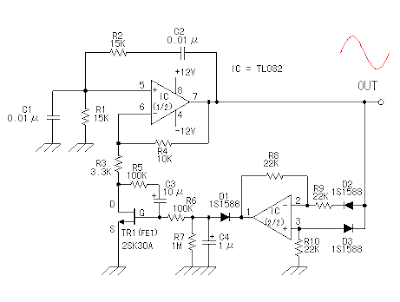
This circuit is a sine wave oscillator which uses operational amplifiers working in oscillation back (positive feedback), or the oscillation output to the input. This oscillator is called Wien bridge circuit is often used. The oscillator Sine wave oscillator is difficult to be done due to the distortion of the oscillation signal, different oscillator square wave, triangle wave oscillator (sawtooth).

Oscillator Sine wave Circuit Diagram

Oscillator Sine wave Circuit Diagram


In the case of C1 = C2 = C, R = R1 = R2, giving the frequency of oscillation and can be calculated using the following formula.

Formula Sine Wave Oscillator


The example of the circuit was made this time is shown below.
f = 1 / (2 x 3.14 x 10 -6 0.01 x 10 x 15 x 3)

f = 1 / (0.942 x 10 -3)
f = 1.062 x 10 3

f = 1062 Hz

The actual frequency of the circuit was 900 Hz.
Read more