Showing posts with label as. Show all posts

Wednesday, November 19, 2014

Transistor As a timer circuit

Basically on all timer or timer circuit utilizing most of the basic characteristics of the capacitor.

Transistor

 The basic characteristic is the process of filling and discharge that occurs in the capacitor. The length of time charging and release depends on the value of the capacitor.

If we observe the above circuit, the light will immediately switch SW1 turns on when we plug it into potensio VR1, this is because the current flowing from VR1 to trigger the transistor base should fill the first capacitor C1. Semakian large capacitance value of C1 then the longer the time required by the transistor to turn on the lights. Then if we connect it to the Ground SW1 then light would soon die and the capacitor will immediately clear the cargo. So can we draw the conclusion that the transistor can be used as a timer circuit using capacitor charging and discharging properties.
Read more

Monday, October 13, 2014

DIY Data Glove Interface Known as HandUSB

Data

Overview

The project can be considered as futuristic as a data glove which can be connected through USB instead of RS232 in order to become an alternative controller for the Pinch Glove fingertip contact glove.

Explanation

A very small SubD adapter housing is used to fit this device as it supports USB standby and consumes low power with 20mA maximum. The device is much faster in responsiveness than the GL-8001 and may later support a USB remote wakeup feature. The project is the reconstruction of a Fakespace GL-8001 device with fully compatible serial interface through USB. The crystal and capacitors can be omitted using the updated V-USB driver. In place of single resistors and multi-diodes, resistor arrays were employed so that it will be easier to populate in case.

V-USB is the basis of writing the firmware where a serial port occurs ready for communication fully compatible to the original GL-8001 box when plugging this device. The baud rate setting is not critical as for V-USB-CDC projects while Windows and Linux have built-in drivers.

A representation of hand interaction is possibly used by Pinch gloves in order to productively work within 3D computer simulation.

Read more

Tuesday, September 23, 2014

Simple Light Dimmer that Doubles as Voltmeter Circuit

Measure AC mains voltage without using a multimeter. All you need to do is to slightly modify the light dimmer fitted at the base of a table lamp for use as a voltmeter. When the dimmer is turned anticlockwise to a point where the filament glow is just visible, that point can be used as the reference point for measuring the voltage.

Light dimmer Circuit Diagram

Light dimmer Circuit Diagram

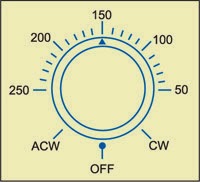
First, remove the old knob and fix a circular white paper around the shaft. Now put back a skirted knob with a cursor as close to the paper as possible and mark two extremities of the pot on the paper as CW and ACW (see Fig. 2).

AC volts scale marking

AC volts scale marking


Switch on the lamp via a variac and feed 50 volts. Rotate the potmeter knob anticlockwise until the filament glow is just visible and mark that point against the cursor as 50V. Keep on increasing the voltage to 100, 150, 180, 200 and 220 using the variac and calibrating the scale for all the voltages. Now a voltage scale is created. The only snag is that the voltage is increasing in anti-clock-wise direction, which should not be a problem. The scale will not however be linear unlike the one shown in the sketch. Accuracy will depend on the calibration standard used and the tolerance is of the order of 1 percent ±5 volts. The diameter of the knob of potmeter and fineness of cursor can be of help in getting better accuracy and tolerance.

Pin configuration of BT134

Pin configuration of BT134


An ordinary fan regulator can be used with a lamp of 40, 60 or 100 watts and calibrated accordingly. The minimum measurable voltage is naturally limited to the one required for ‘just visible’ condition. With R1 open circuited the maximum scale voltage will be around 220 volts.


Author:  G.D. Sekhri Sourced : EFY
Read more